Harmonic Oscillators
#external {.tag .is-dark}
A harmonic oscillator is a useful conceptual tool in physics. Classically a harmonic oscillator, such as a mass on a spring, can always be brought to rest. However a quantum harmonic oscillator does not permit this. A residual motion will always remain due to the requirements of the Heisenberg uncertainty principle, resulting in a zero-point energy, equal to 1/2 hf, where f is the oscillation frequency.
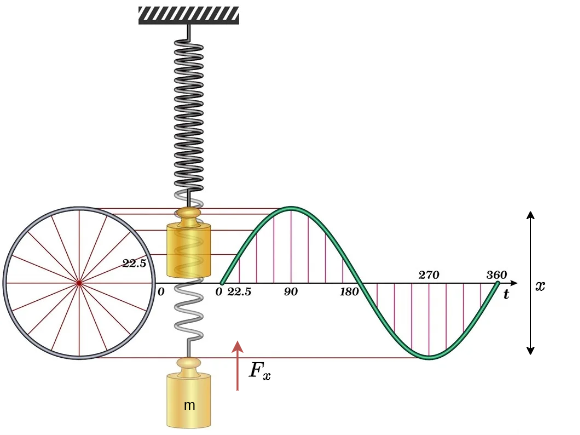
Harmonic oscillators (HOs) are systems that exhibit and are often used to generate harmonic motion, which in most cases are simple harmonic motions (SHMs). SHM is a periodic motion with a sinusoidal time dependence in which the mass returns to its equilibrium position after a certain interval of time, and the acting force is opposed by the restoring force, which is proportional to the corresponding displacement and opposite in direction.
Some standard HOs are the mathematical models of spring, pendulum, elasticity, acoustic waves, electromagnetic waves, AC circuits, molecular vibration, lattice vibration, and several optical phenomena. Although in real-world applications a true harmonic motion is hindered by energy loss due to damping, the incorporation of periodic external energy is used to achieve the desired harmonic motion.
An SHM is mathematically represented by $$ x(t) = A.sin(ωt) + B.cos(ωt) $$where = displacement, = angular frequency, and = time.
Classical Harmonic Oscillator (CO)
The harmonic oscillator wavefunctions
The harmonic oscillator is often used as an approximate model for the behaviour of some quantum systems, for example the vibrations of a diatomic molecule. The Schrödinger equation for a particle of mass moving in one dimension in a potential is $$ -\frac{\hbar^2}{2m}\frac{\mathrm{d}^2\psi}{\mathrm{d}x^2} + \frac{1}{2}kx^2\psi = E\psi. $$ With the change of variable, , this equation becomes $$ -\frac{1}{2}\frac{\mathrm{d}^2\psi}{\mathrm{d}q^2} + \frac{1}{2}q^2\psi = \frac{E}{\hbar\omega}\psi, $$ where . This differential equation has an exact solution in terms of a quantum number : $$ \psi(q) = N_vH_v(q)\exp(-q^2/2), $$ where is a normalization constant and is the Hermite polynomial of order , defined by: $$ H_v(q) = (-1)^ve^{q^2}\frac{\mathrm{d}^v}{\mathrm{d}q^v}\left(e^{-q^2}\right). $$ The Hermite polynomials obey a useful recursion formula: $$ H_{n+1}(q) = 2qH_n(q) - 2nH_{n-1}(q), $$ so given the first two: and , we can calculate all the others.
![[Pasted image 20260926110005.png]]