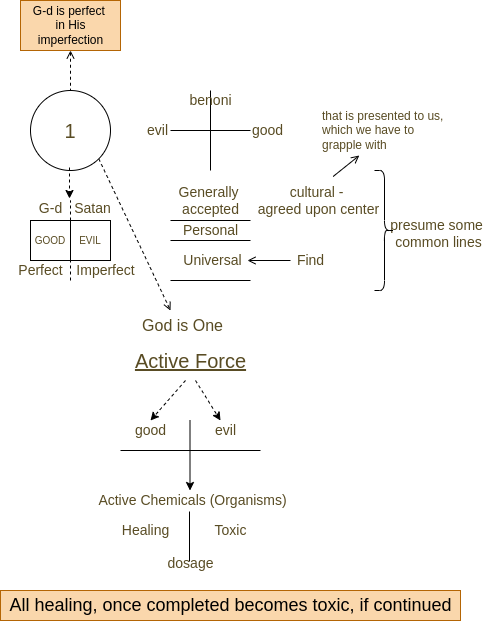
Good and evil are decided relative to the frame of reference, and often the outcome, as well. I say this based on the idea of an absolute good—met by an absolute evil. It seems that the unltimate good and evil are decided by a different set of criteria, one which is referred to as the Will of G-d. If you walk in service to G-d along His Path, then you will find your purpose. If you stray from this Path, there will be repercussions.
This brings up the story of Joseph, thrown into a bit and sold into slavery by his brothers, who are the ancestors of the twelve tribes of Israel. Joseph ends up as the Viceroy of Egypt, and besides saving his family from the famine sweeping the land, he sets the stage for the Exodus and the subsequent Revelation at Sinai, where the Torah was given to the people. Although the brothers behaved abominably, their actions were necessary to set this event into motion. Thus their action was inherently evil, but the result was good. How do we come to terms with the paradoxical nature of this story, unless we accept the concept of a higher concept of good and evil than the black and white one of modern day.
This is looking at it from an external viewpoint, a common good or evil. However on a personal level, one of the essential differences between good and evil is that good always provides us a choice while evil never does. Aah, yes, you always have a choice, the idealists will say—a choice between death (and/or suffering), or to submit to the demands of evil. However, evil also seduces. We often call that addiction.
There are two ways to deal with the Opposer. One is to fight him to the death. Through discipline and willpower, you break his hold on you. The other is to find some balance, because there is often a hidden gem that drew you that can be beneficial to you both. gold in whate
It is one of the reasons we say that God is good - because He allows us to choose whether to follow the impulse to do Good or that to do Evil.
Now we don’t know how much of each there is, nor even how it is distributed in this world. We just know that it is, and it is everywhere! But what we do know is that for every this, there must be a that. So if there is good in the world, there must be evil… for G-d is neither good nor bad—He just IS. The best we can do is build self-contained bubbles of space & time that contain the good—and thus bubbles that also “contain” the evil.
Let’s change perspective, and look at this representation as one that speaks of “how evil, or how good?” And let’s look at it this way:
There will be at least one spot where unadulterated evil can exist just as there is at least one spot where pure good can exist. These define the boundaries of the world of good and evil. While in the realm of the infinite infinities, the infinitely infinite, or the infinity of infinities.... who knows?
Tao - the interplay between light and dark
Let's think of this space as a circle, with the edge of one side being that of pure evil and the other being that of pure good. This then represents the "place", or point, of the purest of good & evil. Inside the circle are all the different gradations and combinations of good and evil. This will bring us to a symbol that is very similar to the Tao, especially if we think of it as a 2d representation of a 3d dynamic.
It could also be thought of as a circle in which the perimeter is one of pure evil and the centre one of pure good.
Though there is a small, perhaps minute, percentage, of pure good or pure evil, most of the space consists of the _benonim_, the in-betweeners or mundanes, who are neither purely good nor purely evil, but an agglomeration of the two. Perhaps seen as an entwining, rather like the connected double helix of the DNA.
### *Benonim*
Thus, in reality, the narrative is about you and I, the benonim, that make up the vast majority of human existence.
If someone is purely good, then there is nothing that needs to be done. He will live a completely sovereign existence according to his inner edicts, and nothing can shake him or divert him. He will draw people to him by his integrity and clarity, but will not seek them out. He will allow them to find him and to leave him if that is not their path.
In the same way, if someone is truly evil, he too will live his life as truly sovereign driven also by an inner (or outer) compulsion. He will influence those around him, and those that he cannot influence - he will bend to his will. This is what makes the force of evil so potent.
The burning question of existence then becomes, if God is the creator of the universe, and therefore omnipotent, was He not the one who Created Evil in the first place? Why, God, oh why? That is a difficult question, perhaps THE essential question of our existence, especially in the midst of this inner battle of the benoni between good and evil.[^1]
I can dedicate my life and consciousness to delving into this question. If I decide to derive my answer for/by myself, it will become a life-long pursuit, which many fail at, or, most often, tire of. I then settle on either a half-baked or/and personalised version of the truth of what I am seeking, or live on shifting sand as I constantly renew my commitments in my search for the answer that will satisfy me, or, most often, just settle on someone else’s answer, or version of the answer.
Whatever answer you settle upon, whatever narrative you choose to describe who you are, will affect how you live your life, and produce many of the consequences thereof.
G-d exists
#G-d
Does G-d exist? The only way one can argue this existential point is by looking at G-d as having been created, which is the anthropomorphisation of the Primal Cause. G-d is not a Man up in Heavens, or any other sort of creation that exists in the realm of our consciousness. Although we refer to Him with a personal pronoun, His essence is non-material, and thus, any human characteristics that we attribute to Him are for our benefit, and do not speak of His being in any shape or form.
Expressed in the prayer:
Praise to the living God!
All praised be His Name,
Who was, and is, and is to be,
For aye the same!
The One Eternal God
Ere aught that now appears:
The First, the Last, beyond all thought
His timeless years!
Formless, all lovely forms
Declare His loveliness;
Holy, no holiness of earth
Can His express.
— Yigdal from Newton Mann
Prior to everything that was created, first of all, and yet himself without a beginning.
Primordial, primary, unbegotten; before the creation, the origin.
Thoughts
#thoughts
G-d is the primal cause.
“Thought cannot rise above the source of thoughts, just as water cannot rise above its source.”
Do you know where your thoughts come from? That you think these thoughts is of course, obvious—but how can you think thoughts, is the question. That science can find evidence of “physical” or electrical manifestations of them in your brain is not proof that your brain is then the source of any of your thoughts. It is like saying that your body is the source of all your feelings. If that is sufficient for you, then you behave as if you are the sole source of all that you are, including your thoughts—then that is as far as you will penetrate the mystery that surrounds us.
Infinite Thoughts
#infinity
Before we can even attempt to define what G-d is(n’t), the question that arises, is whether this universe, this material manifestation is infinite or not. If it is finite, then there must have been a “birth” of the universe (or existence), a “creation”, a primal beginning. What or who (to anthropomorphise) is the Mother that gave “birth” to this creation. Who or what is the Father that provided the seed, which is the alpha of the omega of this creation? There is something—or nothing—that exists beyond, or before, this existence that we are aware of. Now in relation to this infinity, a couple of billion years here or there passes in the blink of an eye. Obviously, if you are dealing with infinite time arguing about a billion or 100 billion years, you have incomplete comprehension of what infinity is.
In the realm of the Infinite (∞)
#infinity{.tag .is-dark}
In the realm of the Infinite everything exists. For instance, can you say that there is a number in the (infinite) set of all natural numbers that is missing? Yet, the number only exists if you “name” it, and for as long as you hold that name in existence. But once that is completed, where does this number actually exist, but in potential, waiting for the “call to duty”, so to say.
And infinity itself—this infinite collection of numbers, for instance, where is it? And how do we derive the conclusion that every number is contained in infinity? Could it not be the same for every object in the universe—emanating from an infinite collection of potential objects? How would we designate, what “name” could we give that infinite collection?
Even if our science claims that it is highly improbable that such a situation could arise, in the realm of the Infinite anything1 is possible, everything that one can imagine could occur, no matter how improbable—for in the realm of what is possible is beyond our capacity to predict.
Thus there could have been multiple universes that were created, and this one just happened to be right for our existence. Those other universes could still be existing, or could have dissappeared. One could even propose that in the realm of Infinity it is inevitable that a universe such as ours would exist. After all, could not all the possible universes have been created and one (or more) of them is correctly attuned for the emergence of conscious beings?
Though that in itself makes this universe, or our existence in it, special.
The fact that we are conscious, and conscious of being conscious, is what is strange about our story. For we know there are other beings that are conscious. But does consciousness necessarily entail beings conscious of being conscious?
Designed or … not
#G-d/design{.tag .is-dark}
Can one really say, with any credence, that this infinite set of universes arose without some “primal will” that is beyond anything any being, conscious or not, can apprehend?
However, the existential question here, is not whether there is a primal cause, but whether there is a design(er) behind it, an intention that directed it. How could we hope to apprehend what the meaning of “intention” is in relation to an Infinite Being? No finite consciousness could hope to achieve that unless it, in fact, it, itself, contained something of Infinity in its consciousness.
Both intention and apprehension are finite concepts anyways—as is all rational science of finite beings who exist in a world in which everything has a beginning and an end. Being finite, he has to, by necessity, impose limits on any endeavour, so that he can shpe its views. This works always within a closed system, which entails keeping certain variables/dynamics of the system fixed while observing others, whereas the Infinite Being works with infinity (and His Minions in higher dimensions). This Being is thus an open system, full of infinite potential and possibilities, containing an infinite amount of finities of which we are just one. One which happens to be “harmonious” to our existence. Thus we say “G-d created the world” or scientifically it might be restated, “An harmonious universe, one in which human beings could exist, arose out of the infinity of possible universes that could exist.”.
Athiest
#G-d/athiest
If this Infinite, Overriding Dynamic is removed from the equation by the atheist, he will then replace it with nothing, or with some other belief system—one that excludes G-d, or whatever G-d represents. Thus one ends up with the two narratives. One that is defined by those that believe in G-d, the Creator, and the other that does not.
However, as they are talking about the same perceived reality, they will inevitably end up talking about the same things, except using different language (and possibly different protocols). Thus, rather than speaking of the Creation, the scientist will refer to it as the Big Bang.
At this stage, most of us have replaced the religious narrative with the scientific one. This is an attempt at a rational description of the creation of the universe, while not taking into account the limitations of rationality.
What we find in this case, is that in the midst of the most rational of times (the scientific age), our behaviour becomes more and more irrational. Now we have reached a trans-human stage, where we believe we can improve on the natural course of evolution with our science, essentially replacing the Creator G-d with some human creation (like AI) despite overwhelming evidence as to the risks and failures of such an approach.
On the other hand, if there is a G-d, and we act ignore His teachings, and act abominably, we blame G-d for creating us (humans) that way.
If we deny the existence of G-d, and we act despicably, who then do we blame when calamities befall us? No-one, for there is no-one to blame, and we may conclude that that is just the way human beings are. If we replace the religious doctrine with a scientific one (eg. evolution) which believes that this violent behaviour is an artifact of being human, then the jaws of the beast can more easily close upon us. They will tell us that they can adjust our nature to make us more peaceful and thus less human. The religious mind would argue, if we are made in G-d’s image, to change that manifestation would be to change the very nature of the human being. However, if that is not the case (as those non-believers would propose), then we are a freak of nature, and thus can be adjusted accordingly.
The essence of a religious doctrine is that at its core is the belief that something that is greater than the human conundrum exists. That there exists a Being, a Consciousness, that is above and beyond ours. One that is Perfect and Merciful and Good, all in a manner that is beyond anyone’s comprehension, and, in holding to that belief, we have faith in the evolution of us as a species. We have a final goal, a place in which we believe human beings can live a better and more harmonious life together. It is not up to G-d to provide that to us… it is up to us to create the communities and societies that will sustain our lives. For us to find better ways to resolve our problems than to violate and kill our neighbours. And through our faith and our belief in a merciful G-d, we believe that is not only achievable, but our predestined course.
If we remove G-d, blessed be His name forever, the saviour, from our equation, then we are left with human consciousness as the ultimate consciousness (as we would then acknowledge no other), and we have plenty of examples of said consciousness being insufficient and incapable of dealing with many circumstances, and downright dangerous and extremely violent in others.
For those who follow this atheistic doctrine, AI would be the ultimate solution. Through the implementation of this AI system, the powerful elites would be able to embed their positions of power. Which is happening as I speak.
AI: A note on AI: Perhaps we have had such systems throughout history, just not referred to as AI. But any system that is imposed from the outside, and forces people to live in a certain controlled manner, is a form of AI. For example, legal systems are essentially just that.
Denial of G-d
#free_will
If HaShem is so powerful, why is there so much difficulty accepting Torah —the blueprint/guidebook to the World to Come? Because we have a drop of the Divine power that is expressed in what is called, “free choice”.
To have any choice in the realm of the Omnipresent Perfection, I have to have the ability to negate the Omnipresence — to believe that there is no G-d, and declare myself part of the Cult of Atheism whose belief structure is build around the core belief that there is no G-d… and all the rest that follows from that guiding principle.
It will thus express itself as an action in the world and the adherents of said doctrine build a life around them that forms around this belief.
Rationality falls into such a belief system, but one that has a serious flaw. Rationality requires a “mechanism”—some set of agreed upon criteria, a protocol of engagement, that will deem something to be rational. The question is whether these criteria are adequate. For the essence of the cosmos does not seem to be able to fit neatly into our rational minds, and it is a misconception to believe that it could.
G!d as King
#G-d/king
The expression of a king is the belief that there are those amongst us who may be above us and control us like gods. Thus, the desire to be king is the ultimate expression of ego. When one reaches this pinnacle of desire it is manifested by one’s entire world being a reflection of the king’s ego. Anyone or anything that doesn’t agree with his ego is immediately ejected.
The problem that occurs here is that a king cannot fully control those who believe in G!d. They cannot be broken from the outside. They stand against the absolute power that the king desires. If G!d is the true King, then He stands above the earthly king—and that is revolutionary.
However, removing the dependency on G-d, replacing it with pseudo-science and AI, which the king controls, enables the earthly king to gain absolute control over his people, body and soul.
There are those who need great monuments and lofty statues to remind us all of their greatness. But if they were truly so great, would their memories not be engraved in the human soul? Because, if the truth be told, many would like to forget the atrocities that have been perpetrated by some of those monumental personages, directly or indirectly, on innocents. The truly wise do not need statues, for they burn their wisdom and (in)sight into our very being, bless them all. For the truth of the wise cuts deeply. They are often vilified and persecuted for their unwavering bravery and adherence to the greater, more authentic, truth than that of our overlords.
Manufactured human artifacts representing the divine are images of fabricated gods. They will, each and every one of them, be representations of the cultural power structure, just as those in power will present themselves as representatives of the gods that they have fabricated. These tales and myths of their exploits and greatness are told to the allay the fears of the people. They are also representing themselves (or the positions that they hold) as gods or as superior in some form or fashion to justify the control structure.
Many want a leader, or a king, to rule over them. Thus the only king that is no-king is the imaginary king, a king so perfect, so kingly, that no human king could ever hope to attain such dignity, This perfect king, or king of perfection, we call G-d, in English. Now if this god is just a king, then he will be like any king, both good and bad. So the only king that cannot be a king, as we know kings, is G-d, the perfect King. How paradoxical! Let us enter the realm of the imaginary. Imagine this G-d of Perfection ruling over everything - and it is, of course, perfect. This king we refer to as “the Supernal Light”—for he existed before there was light—as if it is possible to imagine such a thing. As such, as He is One and in everything—just as the number one is contained in every single other number-–any one can become one with the Infinite One.
Omnipotence
#G-d
If G-d, Blessed is His name, is omnipotent, why could He, the Holy One, not have created something more robust, more conducive to living a good life? NOTE: Did he not?
Because He, the Creator of the Universe, couldn’t! Because He, Blessed is Holy Kingdom for evermore, surely would have, if He, the Great Omnipotence, could have. It must have taken an infinite amount of energy of the Omnipotent to create a single moment of non-ness and we are a product of it! It took billions of years to create this space. By saying that, in the realm of the Divine where there is no time, does not in any way negate the fact that it took “billions of years” worth of energy for this Creation to happen in no-time.
Perfect world
#G-d/perfect
Thus either we blame G-d, or separate evil from G-d, and propose another, equal to G-d, who we call Lucifer or Satan. This denies the essential Oneness of the Divine—“Where there is only One, they see two.” It is an misunderstanding of the concept of the Perfection of The Divine Creator. How could the perfect G-d create an “imperfect” world? Why would the perfect G-d create a world filled with “evil”? Firstly, and most importantly, who are we to judge such a thing? We, who only see a tiny fraction of what IS, are saying that this totality, the immensity of the created world is “evil”, or imperfect? How arrogant, and opening the door to someone claiming to be able to “fix” this broken world—a king, or leader, or even … dare I say it … a Messiah?
Perhaps a better question would be to ask “Why am I here? What is the purpose of my existence?” Which, contains some arrogance within it too—for there is the assumption that my existence does have a purpose—for whom or what? Only if there was perfection, and everything had meaning, would there be the possibility of any purpose for your or my existence. The basis of that assumption is, why then create all of this? Why create a being who is aware of the “imperfection” of his own existence—but this is just according to his view of the universe, not the universal view?
How could I possibly know, really know with certainty, what the truth of my or our existence is? Thus I will grasp at what I can, which will be actions like: having children, being a good person, leading a nation, etc. But there are many who have spent their lives asking this question, who say there is an answer, a deeper answer. But that might inconvenience a comfortable existence—so why bother? Because if my existence is comfortable and I am able, why rock the boat?
As the instinctive way we approach this existential conundrum is from the finite space we are conscious of, it will take a training consisting of years of discipline and practice to connect to the infinite space that exists in us, to realise that from the perspective of the Infinite Eye of G-d, all is as it should be. In fact, how else could it be, extending as it does from Perfection itself?
Unless you are a blessed one, who either was struck by a bolt of realisation, or who always knew that the universe is One, and perfect.
Questions
#G-d/purpose
Constantly asking “What is my purpose here?”, “Why was I born?”, “Why is my life so hard?”, “Why is there evil in the world?”. Who are we directing these questions to? Who would be best to seek answers from?
Let us explore this from a different perspective for a moment. Assume we are going to embark on a long journey. One that might take a lifetime or more. Assume we have set up a communications network, so that we could communicate with our base of operations, and possibly receive guidance from them if necessary. We would have set up nodes for our long-distance communications that would receive and transmit the messages we were sending to our base. These nodes are not just passive transmitters, nor are they passive receivers as messages would affect the behaviour of these nodes - something we call “intelligent” nodes—which would react according to the message received. There are certain trigger or control messages that should cause a shift in the node itself, and in the recipients of these messages. These would be sent when the recipient is in need of adjustment, just as we would send satellites into space to explore the outer reaches of our universe.
The point here is that unless the receiver is clear, and able to receive the messages without any error, how garbled might the messages it receives be? Thus if you are not clear, and have not focused on keeping your mind and your body clear, how could you expect to receive the messages that you would need to direct and rectify your life?
In order to find any answers to these question, it would be necessary to direct them to someone who has spent his/her life in the exploration of such conundrums, through dedicated study and practice—whether dead or alive.
Or perhaps more accurately, there are an infinite set of possibilities available, and we can never really know if one of the “improbable” or “impossible” events will occur at any point. ↩︎