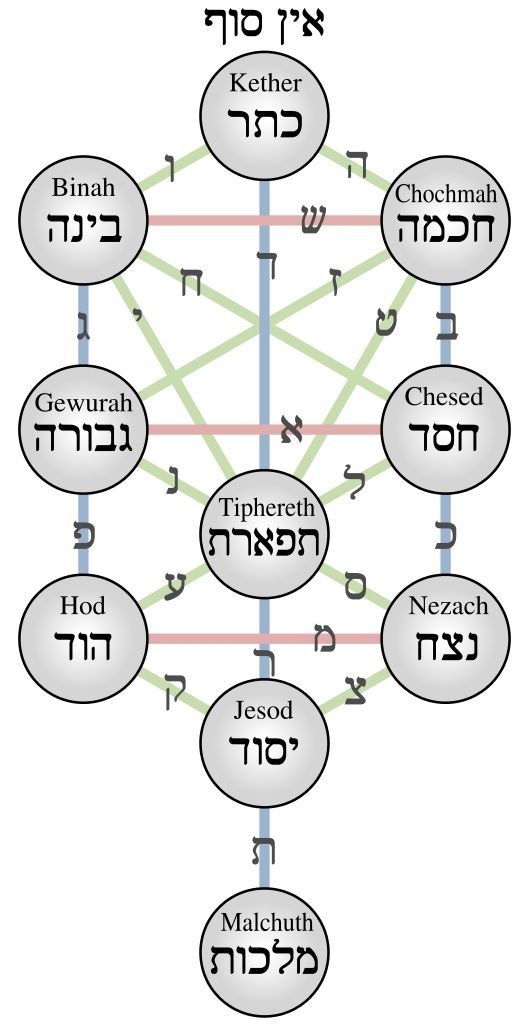
The Tree of Life
The Tree of Life, or Etz Chayim, is a symbolic representation of Consciousness enfolding from more subtle (vibrational) aspects to manifest as the forms we experience as the physical world. It describes the steps through which Energy emerges from the subtle to finally manifest in the material we are familiar with. This “map of consciousness” provides a model for understanding the facet of All Being that is reflected in our own particular being. The map aides us in understanding and appreciating all the available levels of existence, and serves as a foundation for our life journey. The path downward on the Tree is called the Path of Creation, or Emanation, and the path upward describes the Path of Awakening, or Return.
The Tree teaches that the our relationship to reality depends upon the frame of reference within which that reality is viewed — which, in turn, influences and effects how that reality responds to us. From the space of “higher” consciousness, Oneness is clear. From spaces of “lower” consciousness, there is clearly separation. It’s the same reality, only perceived from different points of view.
_500x672.jpg)
This mapping, consists of ten sefirot, or aspects of expression. Early Kabbalists perceived them as circles within circles, which was a perhaps clearer depiction of the multi-dimensional reality in which we exist. By the Middle Ages, the more familiar form of the Tree had emerged. This basic image suggests the human form, reflecting the notion that each human being enfolds the entire Universe in microcosm.1
Each sefirah expresses a certain aspect of the One, and is thus experienced as a specific characteristic of this Energy, representing a necessary stage in the process through which the manifestation that we express emerges from the Absolute Oneness.
Energy flows through each sefirah, expressing aspects of spiritual, intellectual, emotional, and physical (sensory) reality as appropriate. Each is also represented as an area of the human body, as a colour and as a sound. Each has associated with it one of the appellations of G-d, representing one of the aspects of Reality.
It is necessary for this energy to be restricted, and shaped according to this process of gradual enfolding. Imagine that the Tree reflects the flow of electrical energy from the power plant to your home. If the power was directly connected to your house, it would immediately destroy not only all the wiring but even the house itself. So electricity flows from the power plant through a series of transforming stations in which its force is stepped down, so that it enters the home in a usable way. Another analogy is that of the various colours that make up the splendour of the world around us. There is only white light that passes through the object that absorbs all the light, except, for example, green – which we then experience as a green leaf. If all object reflected all the light, we would only see the everything would be white to us.
The ancients liked using the analogy of the sun, as an expression of the force of the divine. There one could say that the idea is that sunlight needs to be “reduced” in order to provide the necessary light needed by living beings. For instance, it needs the approximately 150 million kilometres (93 million miles) or 1 AU, of space to cool down and gather itself, before being further diffused and filtered by the atmosphere before arriving and gently feeding all the living (and non-living). However, if the sun was any closer (or we were closer to the sun), or if we were exposed for too long to bright sunlight, it would cause damage and destroy life.
Fire is similarly an apt analogy, also requiring discipline, control, the correct nourishment, and maintenance to prevent it from becoming destructive.
The Basics of the Ten Sefirot
The Sefirot on the Tree of Life represents the different stages representing the energy as it moves from its most esoteric state to its most physical. The first, and “highest” sefirah, Keter, is the formless kernel of Consciousness. The journey from unmanifest to manifest2 passes from Keter, the Crown, through Chochmah, the vibration of Awareness, then through Binah, the form of an awareness (an idea), then across the Abyss, the final gap between essentially unmanifest and essentially manifest, to Chesed, the vibration of Emotion, and to Gevurah, the form of emotion (or feeling)3, and then Tiferet, the place of balance, or harmony, on the Tree, the individuated, inclusive Awareness4. From there, the flow, gathering at each level the essential nature of that level, moves to Netzach, sensory vibration, and to Hod, sensory form (sensation), to meet again at Yesod, the Foundation of individual identity. Each sefirah receives from above and transmits below, until the final sefirah, Malchut, the Kingdom, receives from them all. Malchut is the space in which the energies coalesce as the reality we experience5.
In this model of the Tree, the seven lower sefirot encompass energies for which we are responsible6. Our meditations during this Omer process are focused on balancing these lower sefirot. The upper three sefirot are prepared for us and are available according to our readiness to receive that greater awareness which is beyond our direct experience.
Learning the Ten Sefirot
One of the lower seven sefirot is assigned to each of the seven weeks of our journey. Within each week, each day is also assigned a sefirah. Thus every day of the process includes the major focus on the sefirah of the week, and an additional focus on the sefirah of the day. This will become clearer as you proceed to the actual meditations.
The goal is to balance the energies of these seven lower sefirot during these seven weeks, but it is helpful to understand how all ten sefirot function on the Tree.
The teachers of Kabbalah associated colours and sounds to the sefirot to provide additional depth to the meditative experience.
The Names of God traditionally assigned to each week are meant as sounds and visualisations for hitbod’dut, or contemplation. Associating the particular Name of God at each sefirah adds auditory dimensions to the image of the Hebrew letters spelling that name.
The colours and sounds are taken mainly from the teachings of 13th and 16th century mystics in Spain and in Safed, represented by Rabbis Abulafia, Moses de Leon, Joseph Gikitilla and Isaac Luria. Each sefirah can be imagined as a sphere of light, within which are visualised the four letters of the unpronounceable Divine Name (Yod-Khay-Vav-Khay)
יהוה
These letters appear in the specific colour of the sefirah. Remember that Hebrew is read from right to left as you learn the shapes of these letters. This four-letter Name is not pronounced, lest we think it represents that which can be limited by word, concept, image or feelings.
Vowel sounds in Hebrew have long been associated with specific sefirot and utilised as ways to meditate on the energies of the each sefirah. The sounds can be vocalised as extended chants, as the specific vowel signs are paired with the four letter Name of G!d.
The Hebrew vowel sounds associated with specific can be vocalised or sensed in the silence of meditation as extended tones, and the specific vowels can be associated with the letters of the four-letter Name of God. For example, the chant at Keter would be “Yee-Hee-Vee-Hee”. The four letters can be chanted on a single breath, or each letter can take up a breath, allowing a greater focus on letter and sound.
Footnotes
This is also a reference to the verse in Genesis that describes Adam as being created in the “image” of G-d (Genesis 1:27). ↩︎
Note that this is how it would be described from the point of view of a manifest consciousness. From this point of view, it would seem that the journey is from the unmanifest to the manifest. However, the journey could possibly be far more complex, with the manifest being only a stage in the full experience. ↩︎
Actually the form of the vibration of Emotion. Remembering that form is in essence trapped energy. ↩︎
It is the place of balance – between the intellectual, the emotional and the physical being. ↩︎
This is essentially where our place is, and our purpose is to transmit our energy in service to the Higher aspects of our being and the Universe, so as to complete the journey of the emergence of each Sefirah. ↩︎
These are the energies with which the manifested is imbued. Our responsibility is to use them to attain a place of higher awareness. To balance and harmonise these energies at play in our beings, just like the conductor of an orchestra must balance all the different instruments to make harmonic sounds that uplift us all. ↩︎