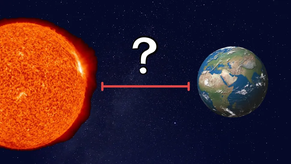
An astronomical unit (AU) is exactly 149,597,870,700 meters (92,955,807 miles or 149,597,871 kilometers), according to the International Astronomical Union (IAU). This is roughly the average distance between Earth and the sun.
Astronomers use astronomical units to describe how far away objects in space are, mostly in relation to the sun or other stars. For instance, Jupiter is about 5.2 AU from the sun, according to NASA.
Because Earth’s orbit around the sun is elliptical (oval-shaped), it isn’t always the same distance from the sun. An astronomical unit represents a practical average, rather than a precise measurement, of our distance from the sun.
Astronomical units are different from some other units of measurement researchers use to describe the distances of objects in space. Another unit is the light-year, or the distance light travels in one year — around 5.88 trillion miles (9.46 trillion km), according to NASA. In contrast, 1 AU is about 8.3 light-minutes, meaning it takes light about 8.3 minutes to travel from the sun to Earth.
Another unit is the parsec, which is equal to about 3.26 light-years, according to NASA. The parsec is a more technical measurement that is derived from an astronomical unit and is used mainly by scientists.
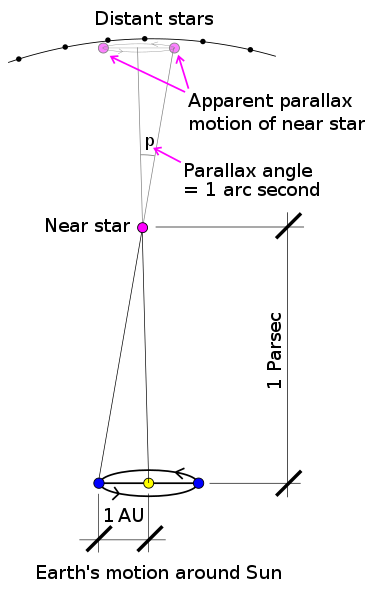
Technically, a parsec is defined as the distance at which 1 AU subtends a one-arcsecond angle (see diagram above). The next-nearest star to the sun, Proxima Centauri, is about 1.3 parsecs, 4.25 light-years or 268,770 AU away.1
Measuring the Universe
The IAU and astronomical units
Scientists use units all the time. The concept of an internationally standardised system of units is one of the most fundamental in experimental science. Everyone uses familiar units such as kilograms, kilometres and seconds and they are indispensable in daily life. Scientists may need more exotic units such as measures of current, frequency and other scientific quantities, but the principle is the same, without an agreed scheme of measurement, scientists could not share results and there could be disastrous and costly mistakes.
The International Astronomical Union (IAU) is responsible for maintaining and approving a special set of units in astronomy, formally defined in 1976. One of the most important of these is the astronomical unit. It is a unit of length approximating the Sun-Earth distance (of about 150 million kilometres) which is of convenient use in astronomy. According to its definition adopted by the XXVIIIth General Asssembly of the IAU (IAU 2012 Resolution B2), the astronomical unit is a conventional unit of length equal to 149 597 870 700 m exactly. This definition is valid irrespective of the used time scale. The unique symbol for the astronomical unit is au. The IAU also defines other astronomical units: the astronomical unit of time is 1 day (d) of 86,400 SI seconds (s) (SI is the International System of Units) and the astronomical unit of mass is equal to the mass of the Sun, 1.9891×1030 kg.
Beyond the Solar System the distances in astronomy are so great that using the au becomes too cumbersome. The IAU recognises several other distance units to be used on different scales. For studies of the structure of the Milky Way, our local galaxy, the parsec (pc) is the usual choice. This is equivalent to about 30.857×10¹² km, or about 206,000 aus, and is itself defined in terms of the au – as the distance at which one Astronomical Unit subtends an angle of one arcsecond. Alternatively the light-year (ly) is sometimes used in scientific papers as a distance unit, although its use is mostly confined to popular publications and similar media. The light-year is roughly equivalent to 0.3 parsecs, and is equal to the distance traveled by light in one Julian year in a vacuum, according to the IAU. To think of it in easily accessible terms, the light-year is 9,460,730,472,580.8 km or 63,241 au. While smaller than the parsec, it is still an incredibly large distance.
Defining a unit is often more complex than first appears. For instance, to define a light-year it is necessary to understand exactly what a year is. When referring to a year in the precisely defined astronomical sense, it should be written with the indefinite article “a” as “a year”. Although there are several different kinds of year, the IAU regards a year as a Julian year of 365.25 days (31.5576 million seconds) unless otherwise specified. The IAU also recognises a Julian century of 36,525 days in the fundamental formulas for precession (more info). Other measurements of time such as sidereal, solar and universal time are not suitable for measuring precise intervals of time, since the rate of rotation of Earth, on which they ultimately depend, is variable with respect to the second.
Reference
Seidelmann, P. K. (Ed.), 1992, Explanatory supplement to the Astronomical Almanac, University Science Books
Footnotes
I cannot understand why we are taking a mean average, which is an approximation, of the distance from the earth to the sun as our basic astronomical unit of measurement. Why are we not using some naturally based unit, as is used to measure a second? Thus light-year was a much more “natural” unit of measurement, if defined as the distance light can travel in a vacuum in a year—all of which can be well-defined. The problem with that is that as our measurement of light changes, becoming more accurate, our light-year would change, thus requiring all the measurements of our cosmos to be updated. This just underlies the fact that all our measurements are relative, so it makes just as much sense to use this AU measurement as it would any other.
What I find fascinating about this AU, is that we are once again looking at the universe from a geocentric point of view! ↩︎