When his Reflections first came out, they barely caused a ripple. There were some who paid it some attention. It garnered mention in certain circles, but it did not make it into any mainstream announcements. Then, out of the blue, the ripple grew surprisingly swiftly into a wave, for the truth has a mysterious way of sprouting when the time is right. Like a mushroom it bloomed, full of juice, affecting all those who came into contact with it with its mysterious energy.
As time went by, it became obvious that many of the predictions in the book were eerily accurate. But that was not the amazing part of it. What was was that in many cases a solution to the problem was offered. Admittedly, they might not be the optimum solutions. However, as the author makes clear early on, the intention is not to find a solution, but rather a system that can foster, support, nourish and encourage innovative solutions to challenges that we (as a society) are constantly in dynamic encounters with.
But I am running ahead of myself. I was just a child when I first encountered the stories. They hinted at the existence of a great mystery. The story was of a hero who set out on a journey to find the secret of life. The one that, not only would fill his life to the brim, but would make him famous and wealthy. A secret that would enable him to leave a great legacy. But, as he grew older, he realised that the story was more complicated, and that the map was coded in an ancient tongue, a language that existed before human civilizations arose. It would take many years before he would be able to even understand this language, let alone read and interpret it.
The book ranges far and wide, and moves from number mysticism, to quantum effects, on to topology and set theory, Cantor’s aleph of infinity, Whitehead’s process philosophy, Steiner’s geometry of infinities with equal ease. Although it may seem that it runs all over the place, and believe me, it does, there is a sense that there is a guiding light, a coherence that is not immediately apparent, that is followed. A intuitive feeling of some underlying order, or understanding – or perhaps it is just intelligence (or, as he would say, trained intellect!) – that runs beneath it all:
But heard, half-heard, in the stillness
Between two waves of the sea.”
— T.S. Eliot – Little Gidding
As much as there might be any interest in the content of the book itself, it becomes an investigation into what that underlying “intelligence” that lies behind this unfolding diatribe is. There is no hint of channelling this from some other worldly entity. It is claimed to be a purely intellectual/imaginative investigation with much help from an ancient living tradition, which he claims to have been schooled in – that is largely hidden, in plain sight, I might add. Unfortunately, the old adage, “None so blind as those who do not wish to see”, seems to be appropriate in this case.
I. Information
This, ladies and gentleman, is the essential challenge that any content that speaks of unknown or dimly perceived information. “How does one transmit the information of an experience that the recipient has never had?”
This produces what one could call the first separation, and that is between those who have had the experience, and those who have not had the experience. Thus one needs to separate one’s audience into two types of people: those who have had a certain shared experience – like, for instance, childbirth or sex; rape or incest; cancer or heart-attack – and those who have not. Although every human being has the ability to have any possible human experience, each one of us have only experienced a specific set of them – and that connects us on a deeper level than the is generally acknowledged.
Thus one needs to accept that this is essentially a “book of a mystery teaching”, that is, it presupposes a spiritual evolutionary journey towards higher consciousness that will introduce greater balance and harmony within and without. Thus we arrive at our second premise, that this is the essential purpose of our time here, and becomes the driving force from which everything that follows is viewed.
II. Inner & Outer Aspects
Let us begin from the fact that there are two possible aspects to look at anything. From within looking outward or from outward looking in. This is referred to the “viewing from infinity” or “viewing from the finite” which could also be referred to as the ‘internal perspective’ versus the ‘external perspective’. From this position we also arrive at the dynamic referred to as "the influence from above" and the "influence from below". The first being the infinite, transcendent aspects of our existence, and the second being those over which we have some control and individual say.
This brings us to the society in which we live, which is a human based experience of this. It is the controls necessary for a smoothly running society, as well as the methods of maintaining control by the power elites of said society. That is the reason they would like us to think of them as gods, or the offspring of gods, as to become confused and think that they are expressing the "will from above", which cannot be true, as there is only One who expresses this will from above and all the rest are only His servants.
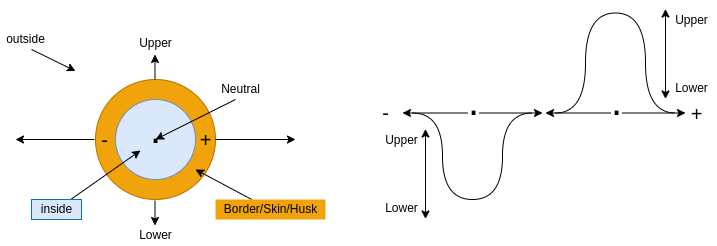
The field that has to some extent investigated this perspective is projective geometry. Rudolf Steiner's book on the subject is one that which approaches it from a more esoteric viewpoint, as well as being more accessible to the non-mathematically inclined. This geometry looks at objects from the infinite perspective, whereas the geometry that we are most familiar with, viewed an object from the viewpoint of the observer, and the infinite resided in the distance. This is, what might be described as, an egotistical viewpoint - just as our forefathers viewed the universe from the earth outward, believing that it was the "centre" of the universe. This is normal behaviour, starting from the place that we are at, the place that we know of. Our experience begins with us as the center, and then, through experience, we encounter the “other”, or “outside” objects. This is the general unfolding of our human experience.
It takes training and practise to be able to view things from the infinite perspective, rather than from our natural place as the “centre”.
Using art as a representation, the book delves into the history of art, at least in Western Civilization, showing that in the beginning, most representations (with notable exceptions in a 3d medium, like sculpture) were flat, 2d, representations of our reality. Only during the Reformation did these artists begin to project theirepresentations into the 3rd dimension, as we are used to today. With the advent of movies, we added the “dimension” of movement, which produces time, into our representations, so that brought stories out of the imagination and into sequences of pictures.
It is pointed out that these are not really moving pictures, but, just like the reality that we are presently perceiving, it is just an illusion of movement. We are actually fooled into seeing these pictures as moving as they are actually being shown to us in a linear, time-bound sequence “picture-by-picture.”
“As the mind has a frequency of about 1/10 second, so a moving film with more than 10 frames per second presented to an audience for viewing would seem continuous. Just as in our physical universe time marches forward at a specific step rate, in apparent packets of information.”
Thus the question is approached as to whether the universe is continuous, or also made up of discreet packets of information. For if whatever was measuring or perceiving it was only able to do so in discreet packets (known today as quanta), how would these measurements ever be able to prove true continuity?
Historically, this was the movement from a 2d perception of the world, to a 3d that included depth. Then, by introducing another dimension that of time, we saw our story as one of a continuous reality. However, realising that time is present in every dimension, whether 2 or 3 or higher - or rather, time is present in every story, every evolution, every life - it does not seem correct to look at the, so-called, 4th dimension as being time.
III. Non-sensible
However, upon science discovering the non-sensible (in that they were unable to be sensed by our 5 senses), it opened up the possibility of another space that acted on this space of existence. Using the concept of dimensions places the discussion in framework in which it is easier to visualise and explain the existence of such a "supra" existence. By referring to this as a 4th (higher) dimension acting upon the 3rd, it can be brought closer into a rational scientific paradigm.
Even in the "old" times, those more simpler 2d viewpoints, which we think of today as flat, there was the simpler this and that. There was a material, known world and another esoteric unknown world that acted upon - i.e. had an influence upon - this world. In those days, we referred to that world as the spiritual world, where there were active beings who lived in that world, and not only related to ours, but we could influence.
Today, that world has been relegated to the Newtonian concept of determinism, governed, just as we have described this physical world, with set laws.
This certainty has been assaulted by the quantum concepts based on fragile concepts like probabilities, and imaginary numbers and spaces. It has become a world in which so much of what is in the mind will affect what happens in the real world. Just as superstitions could influence our behaviour, so can pseudo-science - which is a modern world for superstition, which itself could have been referred to as pseudo-spirituality.
At present we are embarking on being able to receive 4d representations of our world – the caveat here is that only some of us will be able to understand these 4d representations, not all of us. To quote, “In every step of evolution, there must be those left behind – to “hold the fort”, so as to say. Another, more mathematical way of saying this, “Every 4d object can be represented by an an infinite collection of 3d objects, and every 3d object can be represented by an infinite amount of 2d objects....”
This is saying that there will always be those who can only conceptualise the world as a 2d, or 3d world. Nothing more, nothing less. While the new/old frontiers are opening up in the realm of the unseen, which has been apparent from ancient of days.