Zero point
Zero-point refers to the lowest quantized energy level of a quantum mechanical system — the energy of the system at temperature T=0.
The origin of zero-point energy is the Heisenberg uncertainty principle, which states that, for a moving particle such as an electron, the more precisely one measures the position, the less exact the best possible measurement of its momentum (mass times velocity), and vice versa. The least possible uncertainty of position times momentum is specified by Planck’s constant, . A parallel uncertainty exists between measurements involving time and energy (and other so-called conjugate variables in quantum mechanics). This minimum uncertainty is not due to any correctable flaws in measurement, but rather reflects an intrinsic quantum fuzziness in the very nature of energy and matter springing from the wave nature of the various quantum fields.
Zero-point energy is the energy that remains when all other energy is removed from a system. This behaviour is demonstrated by, for example, liquid helium. As the temperature is lowered to absolute zero, helium remains a liquid, rather than freezing to a solid, owing to the irremovable zero-point energy of its atomic motions. (Increasing the pressure to 25 atmospheres will cause helium to freeze. An atmosphere (atm) is a unit of measurement equal to the average air pressure at sea level at a temperature of 15 degrees Celsius (59 degrees Fahrenheit)).
Harmonic Oscillators
#external {.tag .is-dark}
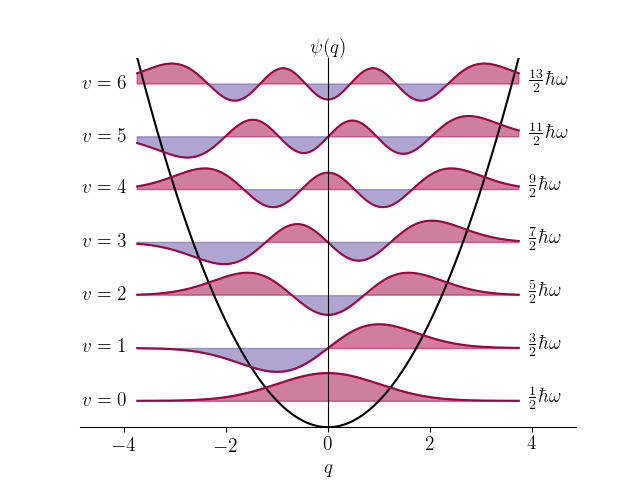
A harmonic oscillator is a useful conceptual tool in physics. Classically a harmonic oscillator, such as a mass on a spring, can always be brought to rest. However a quantum harmonic oscillator does not permit this. A residual motion will always remain due to the requirements of the Heisenberg uncertainty principle, resulting in a zero-point energy, equal to 1/2 hf, where f is the oscillation frequency.
![[…/science/assets/Zero-point energy/Harmonic Oscillator 01.png|Image Credit: Fouad A. Saad|500]]
Harmonic oscillators (HOs) are systems that exhibit and are often used to generate harmonic motion, which in most cases are simple harmonic motions (SHMs). SHM is a periodic motion with a sinusoidal time dependence in which the mass returns to its equilibrium position after a certain interval of time, and the acting force is opposed by the restoring force, which is proportional to the corresponding displacement and opposite in direction.
Some standard HOs are the mathematical models of spring, pendulum, elasticity, acoustic waves, electromagnetic waves, AC circuits, molecular vibration, lattice vibration, and several optical phenomena. Although in real-world applications a true harmonic motion is hindered by energy loss due to damping, the incorporation of periodic external energy is used to achieve the desired harmonic motion.
An SHM is mathematically represented by $$ x(t) = A.sin(ωt) + B.cos(ωt) $$where = displacement, = angular frequency, and = time.
Classical Harmonic Oscillator (CO)