3 splendours (pp 90,96)
tzachtzachot - צחצחות
There is a connection with the Trinity and the three faces of the Hindu deity, and the trigram of the I’Ching.
צמצם or צימצום is the Kabbalistic tsimtsum, or constriction — through resistance begins the manifestion. Going from the spiritual, almost virtual energy to the grosser, thicker, slower energies that are the manifestations we are aware in. As such, it is a seen as circular, an expanding or contracting spiral.
One bifurcates. Two are manifest, the third splendour is the one that emerges as the relationship between the two manifest. It may emerge in multiple forms too, as the doubling, or joining of the two. It also continues the process of life, the bifurcation.
Perhaps the 3 are just really 3 out of the 10. As Judah Hasid mentions the 10 spheres, or ספירות… These are the 3 that are manifesting the known world. The rest are expressions, or steps into the ineffable. It seems that there are the 3 at the top, the six that make the One, and finally the Kingdom, מלכות, that manifests.
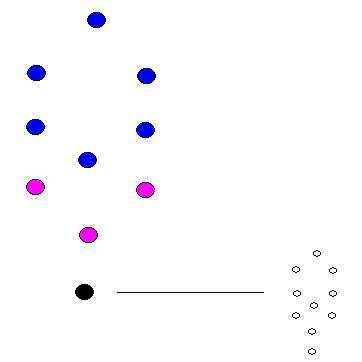
Of course, within מלכות, the pattern begins once again — the unmanifest, inner radiation of אין סוף.
An aspect of the finite within the infinite, is that in order for it (the finite) to be eternal, it will have to return to its original form at some stage.
His is the Law, carried down from heaven. If the same structure, the same pattern, applies to both then obviously the same influence, the same laws, will have the same effect.
If אין סוף is manifest, then It contains everything,
In the beginning,
there was אין סוף
Then nothingness,
Then the 3 splendours,
Then 1st emanation
Then the Manifestation
G!d in relation to his creation
Assumes the existence of G!d.
G!d in relation to Himself
Is Incomprehensible
For He is a part of us,
And we are part of Creation.
The kabbalist
I was born in the cauldron of creation
A kabbalist does nothing... except perhaps pray — with all his heart and soul. All his work is in the upper realm. The one referred to as the imaginal realm. A realm exemplified by the imaginary numbers of mathematics, producing, through the intermarriage of the real and the imaginary, the realm of the complex.
He performs the acts necessary to maintain his physical being, but only in order to pursue his calling and work in the upper worlds.
Working as close to Source as he is able to, he has no apparent effect on anything tangible. As we are all connected to this source, his work can affect anything and everything. However, how long it will take till his actions manifest some effect, depends on many factors, both known and unknown.
Kabbalah is a way of life.
In the past, in order to learn Kabbalah, or participate in this way of life, one had to be fully immersed in the Jewish tradition. Presently, it seems, that Kabbalah is often used as a means of drawing new age proponents into the Jewish fold. I'm afraid I don't really live up to the "requirements" of the modern (or ancient) Kabbalistic meme. However, I feel a connection with HaShem, Adonai and the Elohim almost constantly, hovering in the space between the immanent and the transcendent – in dialogue with both. Kabbalah has helped me to find a language with which to express that, and a means with which to come to terms with my "practice" thereof.
But living as a singular Jew in the mountains of the Eastern Cape—"frontier" country as it is called—brought here, btw, by following the flame by night and the cloud by day, I suddenly stepped into my own dream, and found my practice slipping. That space being filled by sublime moments alone and in communion with the greater "I" that surrounds all.
In depth
G‑d said to Moses: “Come in to Pharaoh” (10:1)
Rabbi Shimon [bar Yochai] continued: It is now fitting to reveal mysteries connected with that which is above and that which is below. Why is it written, “Come in to Pharaoh”? Ought it not rather have said, “Go to Pharaoh”? It is to indicate that G‑d brought Moses into a chamber within a chamber, into the abode of the supernal mighty serpent that is the soul of Egypt, from whom many lesser serpents emanate. Moses was afraid to approach him, because his roots are in supernal regions, and he approached only his subsidiary streams. When G‑d saw that Moses feared the serpent, He said, “Come in to Pharaoh.”
(Zohar)
**We will go with our young and with our old, with our sons and with our daughters (10:9)
**
Pharaoh was willing to let the menfolk go, as long as the children remain behind; for as long as the younger generation remains “in Egypt,” there would be no future for the people of Israel.
The “Pharaohs” of our day have the same attitude. If the older folk wish to cling to Jewish tradition, that is perfectly acceptable; but the youth should be raised in “the spirit of the times” . . .
(Maayanah Shel Torah
Stretch out your hand towards heaven, that there shall be darkness over the land of Egypt (10:21)
Why did G‑d . . . bring darkness upon the Egyptians? Because there were transgressors in Israel who had Egyptian patrons and who lived in affluence and honor, and were unwilling to leave. So G‑d said: “If I bring upon them publicly a plague from which they will die, the Egyptians will say: ‘Just as it has passed over us, so has it passed over them.’” Therefore He brought darkness upon the Egyptians for three days, so that the [Israelites] should bury their dead without their enemies seeing them.
(Midrash Rabbah
A man did not see his fellow, nor did anyone get up from his place for three days (10:23)
There were six days of darkness. . . . During the first three, “a man did not see his fellow”; during the last three days, one who was sitting could not stand up, one who was standing could not sit down, and one who was lying down could not raise himself upright.
(Midrash Rabbah)
There is no greater darkness than one in which “a man did not see his fellow”—in which a person becomes oblivious to the needs of his fellow man. When that happens, a person becomes stymied in his personal development as well—“nor did anyone get up from his place.”
(Chiddushei HaRim)
G‑d spoke to Moses . . . : “Please, speak into the ears of the people, that every man ask of his neighbor, and every woman of her neighbor, articles of silver, and articles of gold . . .” (11:2)
Why was it so important that the children of Israel should carry out the wealth of Egypt, to the extent that this was foretold hundreds of years earlier to Abraham as an indispensable component of their redemption?
Every creation contains a “spark of holiness” which embodies its divine purpose. When a person utilizes an object, force or phenomenon to serve the Creator, thereby realizing its function within G‑d’s overall purpose for creation, he “redeems” and “elevates” the divine spark at its core.
Every soul has its own “sparks” scattered about in the world, which actually form an integral part of itself: no soul is complete until it has redeemed those sparks which belong to its mission in life. Therein lies the purpose of galut in all its forms: the exile of the soul from its sublime origins to the physical world, and the various exiles that nations and individuals experience in the course of their history, impelled from place to place and from occupation to occupation by seemingly random forces. All is by divine providence, which guides every man to those possessions and opportunities whose “spark” is intimately connected with his.
As the father and prototype of all exiles, the Egyptian galut was a highly concentrated period of history, in which the foundations were laid for all that was to unfold in subsequent centuries. The material world contains 288 general “sparks” (each of which includes innumerable offshoots and particles); of these, 202 were taken out of Egypt, redeemed and elevated when the Jewish people carried off its gold and silver and used these to construct a sanctuary for G‑d in the desert (see Exodus 25–31).
(The Chassidic Masters)
Time is the first creation (see Sforno on Genesis 1:1); thus, the sanctification of time is the first mitzvah commanded to Israel.
(Lubavitzer Rabbi)
A mixed multitude went up also with them (12:38)
The Hebrew word rav (“multitude”) has a numerical value of 202; the “mixed multitude” represents the 202 sparks of holiness that the Jewish people extracted from Egypt (see commentary on 11:2 above).
(The Kabbalists)