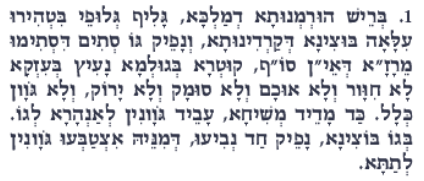
At the head of potency of the King,1 He engraved engraving2 in the lustre on high.3 A spark of impenetrable darkness4 flashed within the concealed of the concealed,5 from the head of Infinity6—a cluster of vapour forming in formlessness, thrust in a ring,7 not white, not black, not red, not green, no colour at all.8 As a cord surveyed,9 it yielded radiant colours. Deep within the spark gushed a flow, splaying colours below, concealed within the concealed of the mystery of Ein Sof.10 It split and did not split its aura,11 was not known at all, until under the impact of splitting, a single, concealed supernal point shone, so it is called ראשׁית (Reshit), Beginning,12 first command of all.13
This is the description of the process that ignited creation for the Zohar, the book that stands as the foundation from which Kabbalah, as we know it today grew. Zohar, זהר, Radiance illuminates the Torah—not the book, but the actual Radiance that could be described as the dynamic of creation. And that is what the Zohar, the book, also provides. It illuminates the words of the Torah in ways that lead us—if we are able—to an more dynamic version of the words.
I have chosen this passage, as there are many books, courses and videos available that describe the structures of the Kabbalah in great detail. However, what is important to focus on is the fluid nature of these forms—remembering that all of the words used to describe these forms have other, esoteric functions as well. That is, never take these words literally.
Here are some examples from this passage to provide a taste of what I am referring to. But before doing that I suggest you spend some time to meditate on this dynamic account of the unfolding of creation, as it is described here. Notice the dynamic nature of this description.
With the authority of the King, Ein Sof, He aroused Himself to issue this beginning decree, by which He engraved the engravings that we know as the Sefirot by which the brilliance of the first sefirah, Keter, which is co-eternal with Ein Sof shone from on high. From within this highest of sefirot, the concealed of the concealed, at the head of Infinity, known as Ein Sof, the ultimate divine reality which has no end, a spark of impenetrable darkness flashed—the lamp of impenetrability, בוצינא דקרדינותה (Botsina da-qardinuta).
This spark is so potently brilliant that it overwhelms comprehension so it is conveyed with many similar paradoxical images like “the luminous darkness" (Gregory of Nyssa, Life of Moses 2:163), “the black light” (Iranian Sufism), and “the light darkened from shining” (Azriel of Gerona). Maimonides described it thus: “We are dazzled by His beauty, and He is hidden from us because of the intensity with which He becomes manifest, just as the sun is hidden to eyes too weak to apprehend it’s light.” This blinding spark is the first impulse of emanation flashing from Ein Sof through Keter and proceeding to delineate the various sefirot. The goal of meditation is to attain this spark and participate in the primal flow of being. There is a connection between qardinuta and measurement (Liebes, Peraqim, 146-49, 162-163), as well as some phallic connotations (Worfson, Circle in the Square, 60-62) of the phrase, one of the interpretations, the “hardened spark” (Liebes, Zohar v’Eros, 73-80).
A cluster of vapour קוטרא בגולמא (Qutra be-gulma) — meaning both “knot” and “smoke” — formed in formlessness, not white, not black, not green, no colour at all. These four colours are associated with the sefirot, Chesed, Shekhinah, Gevurah and Tif’eret, none of which appear until a later stage of emanation. As a cord surveyed, it yielded radiant colours. This spark that is a vapour is also a cord (משׁיחא [meshicha]), a line of measurement that maps out the paths and stages of emanation, the spectrum of divine colours, each with its own wavelength.
Deep with the spark gushed a flow, splaying colours below, concealed with the mystery of Ein Sof. The flow of emanation has just begun; everything still hidden within the mystery of Ein Sof.
It split — and did not split — its aura. Somehow the flow broke through, but the nature of the breakthrough is impossible to describe, so that act is stated and immediately denied. The aura (אוירא [avira]) is literally air, but can also represent space, æther or aura. “Out of chaos, He formed substance, making what is not into what is. He hewed enormous pillars out of æther that cannot be grasped” (Sepher Yetzirah 2:6). He called to Ayin (אין), nothing, and it was split, to something (ישׁ [yesh]), and it was thrust. There is an interesting parallel to the Orphic myth of the hatching of the cosmic egg (Liebes, Studies in Jewish Myth), 79-84.
It was not known at all, until under impact of splitting, a single, concealed, supernal point shone. Here the flow of emanation manifests as a point of light. This is the second sefirah, Chochmah (“Wisdom”), called Beginning because it is the first ray of divine light to appear outside of Keter, the first aspect of G-d that can be known. The association of Beginning, ראשׁית (reshit), with Wisdom appears widely.
Beyond that point, nothing is know, so it is called ראשׁית (reshit), Beginning, first command of all.
