Principle of negation
For every this, there is a that.
This states for every thing that exists there exists a negative, an other. We speak of anti-particles, and anti-matter. But there are two types of others.
There is the equivalent other, represented, for instance as in: if , then , more familiarly, in the whole number system, for every there is a . We can extend this to say that could be a composite (just as could be) – for instance, a weight. This . It does not say that they are necessarily equal.
However, there is another possibility. We could propose an other that is everything P is not, which we could designate as not-P, or . If the universe, , is infinite, then so is not-P which equals . A more poetic way of expressing this might be to say not-P is the space in which P is received. By examining not-P, you might stumble across P hidden in its depths.
We could say these two cases define the total space in which any event takes place.
Trinity
Every object has at least three shapes: inner, outer and the border between.
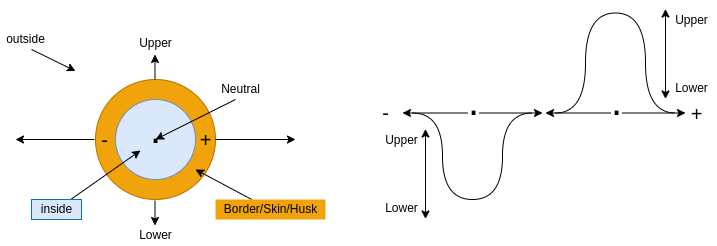
Here we have the inside, the outside and the skin that differentiates between the two. If there is an upper and a lower, then there is a “line” that is neither upper or lower that marks the place at which the upper becomes the lower and vice versa.
3 states, 3 responses, 3 reactions: positive, negative & neutral; for, against, not-sure; beginning (), end (), middle—which is everything inbetween which forms the conscious or “visible” segment.
This is what differentiates a field from an object that has a shape. Energy can pass through most things, and it may, or may not, affect it. And object can pass through energy too, and, are most often unaware of the effect it might have upon them.
Excluded middle
For every P, there is a not-P such that not(not-P) = P
This not-P is represented by -P. This is a stronger case. It proposes that for every this, there is an equal and opposite that. In other words, one can pass from the one to the other, and there is a balance between the two. One could say that this -P is the exact opposite of P, almost like a mirror reflection. This is a strong philosophical position, on which most of modern mathematical proofs are based. Now, in the realm of mathematics, the realm of ideals and thought, in which a certain purity is maintained, this might be possible. However, the real world, the world of existence, to balance this equation is not easy, and there are many examples of this not being true. [Todo: Give some examples]
In fact, for many experiments to be able to take place, one needs to ignore all the factors that might taint the purity needed to ensure that what is being focused upon is clear, and anything that might affect that purity, must be excluded. In other words, ensuring that the excluded middle holds.
This also illustrates the Principle of the Anti, or Karma: “For every action, there is an equal and opposite reaction”. In quantum theory, for every sub-atomic particle, there exists an anti-particle.
I extend the statement to: “For every event in the universe, there is an equal and opposite event”.
Included middle
Between P & not-P, there are infinite potentials.
The excluded middle is just one possibility. Just as between any two points there are an infinite amount of lines possible, with the straight line—the one that is most convenient to us—being a single specific case.
That might depend on what is being measured. However, we will only consider the case where they are equal. This not-P, which we have designated as -P, to differentiate from not-P, as being a non-P—everything that P is not, which would be everything besides P itself, “non-P = U - P”. This is represented as ~P, which, if U representing the “universe” under discussion, is infinite, then, is itself infinite.
Vesica Pisces
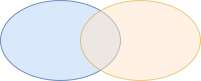
Two ways to deal with the middle: the excluded middle (used mainly in mathematics, and logic, and dictatorships), or the included middle.
The boundaries of the space are defined (expressed) by the extremes or the limits of that space. Thus is why the extremist, those we term fanatics, or zealots, can have such a profound effect upon our societies.
The centre will always have an influence, and its dynamic is to perpetuate itself— the desire to live forever.
In living beings, the inner represents the observer, the I, and the outer represents the observed, the situation. The border, or skin, demarcates a field of “awareness”, resulting in an interaction - what we might refer to today as entanglement. It is also the place where all interactions with the outside first occur.