- Introduction
- Chapter 6
- Chapter 7
- Chapter 8
- Chapter 9
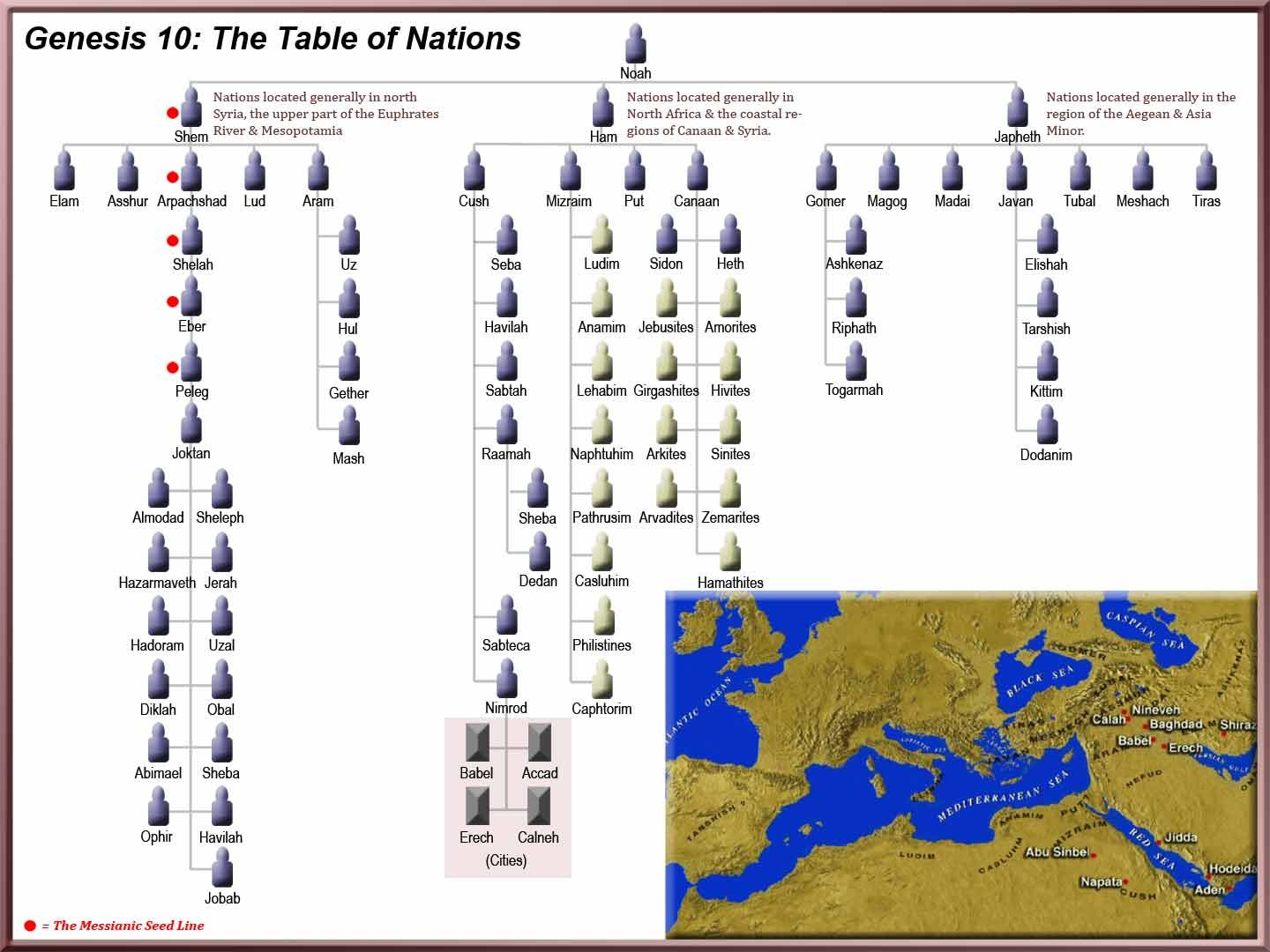
- Chapter 10: The seventy nations
- Chapter 11: Babel
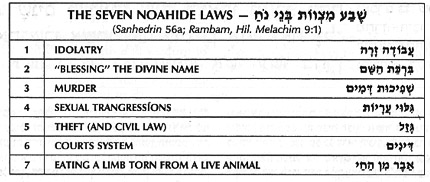
- The Seven Noahide Laws
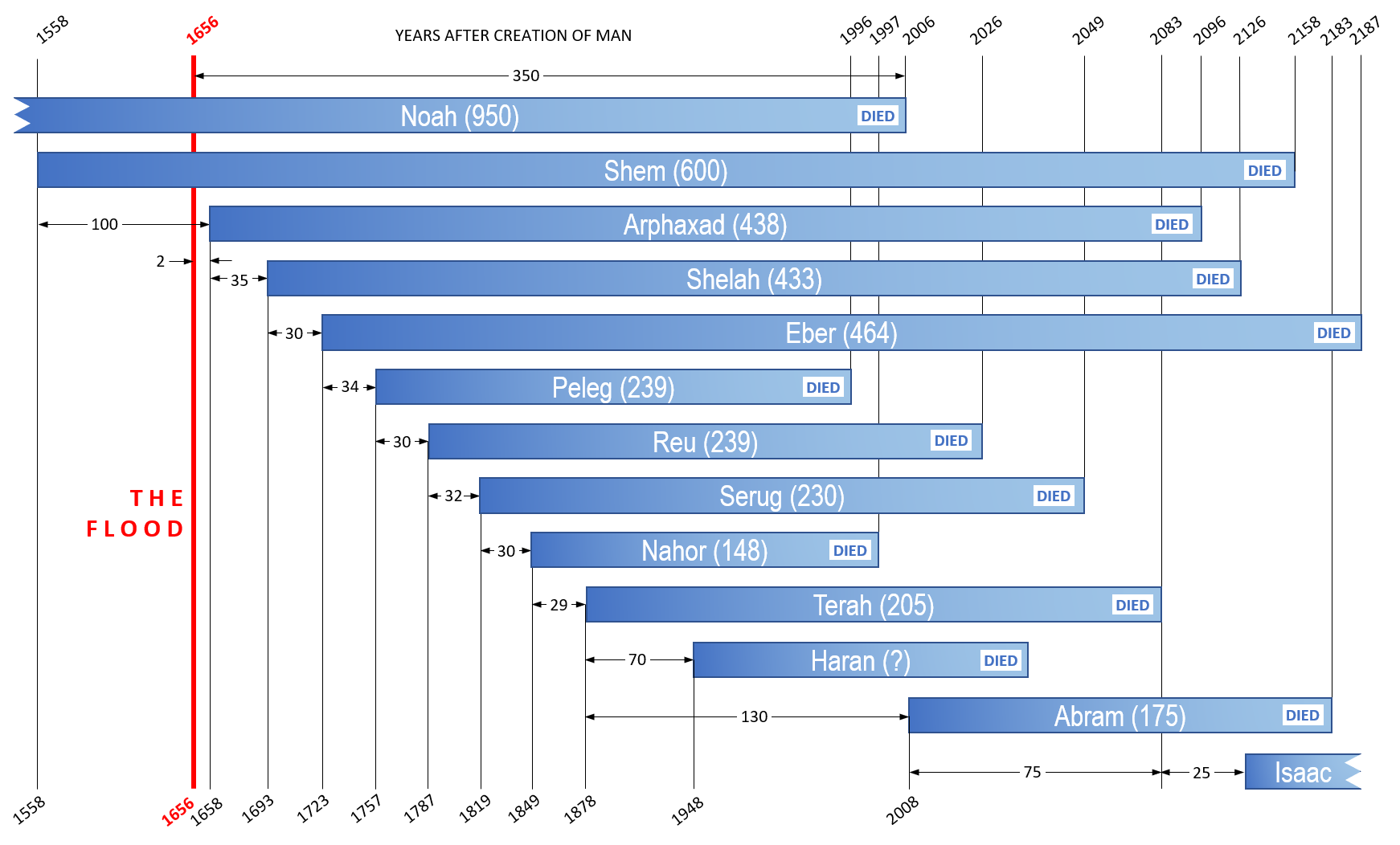
- Chronology/Time Lines
Introduction
Note The first parasha, Bereishit starts off with the universe in tohu v’bohu, darkness and confusion. The second, Noah also starts off with darkness (corruption) and confusion (robbery). The first is the story of the creation, the beginning of the Universe. The second is about the “creation” of mankind, their beginning.
In both there is a progenitor. In the first, Adam, the androgyne, appears. He is then separated into the male and the female, who then sin, and as a result, they cover their nakedness, and are expelled from the Garden of Eden.
In the second, Noah, who is righteous, upon emerging from the flood sins by getting drunk and exposing his nakedness. He too was expelled, though in this case the “garden” was removed from him previously — by the flood.
Imagine everyone on the planet getting annihilated, and you were the only person (you knew) who survived. Everything that had come before, all your friends, the society that evolved around you, everything had been denuded and you had to begin again alone (with only your family which at that point consisted of your wife –whose name is never mentioned– and your three sons and their wives.) That is the “garden” to which I refer.
Chapter 6
6:9] Righteous man
n6:9] נֹ֗חַ אִ֥ישׁ צַדִּ֛יק — Noah was a righteous man. The primary “offspring” of the righteous are their good deeds, for the worthwhile things that a person does are his prime legacy. (Rashi) A person should work hard to perfect his deeds, just as he spares no effort to help his children. (R’ Moshe Feinstein)
Note Noah is the only person in the Torah that is referred to as righteous. Yet, he promptly got drunk upon surviving the flood (perhaps his mind couldn’t handle it. It is interesting the contradictions often. Jacob is know as Truth, yet he stole the birthright from His brother, and lied (deceived his father).
Note “… perfect your deeds…” This implies that it is possible to reach such a height of perfection.
n6:9] בְּדֹֽרֹתָ֑יו — In his generations. There are two ways to look at this statement. The first is that it is in praise of Noah, who was righteous even while his generation was corrupt. How much more righteous would he have been had he been surrounded by righteous people?
Note ”In his generations”: Though if he lived for 600+ years, was that only one generation of people around him? Was the 600+ years of his life specific to Noah? Perhaps many people lived long (600+ years) lives. This is pre-flood, so the earth was populated at that time.
Question “How much more…?” This implies that, although righteous, he had not yet reached perfection. It also implies that the righteousness of his deeds would have reached higher levels if he had been surrounded by others who were righteous… Is that true? Does this not contradict the statement that “the single candle shines brightest in the darkest hour”? Or that it is easy to be righteous when surrounded by righteousness – is that not the very argument Moses uses against the angels objections to the Israelites receiving the Torah – as opposed to the righteousness of one who is righteous when everyone else is practising their evil ways?
The second is more critical of him, claiming that he was righteous only in his generation, by comparison to his wicked brothers (Rashi). Accordingly, the righteous of each generation are judged in terms of their own time (Sefer HaParshiyot).
Note Only if we accept the first interpretation, that he was righteous in his generation, can the latter hold true.
Question This is another human interpretation. Does God (or the avenging angels) recognise the generations? Is not each one judged by the choices we make in a specific situations? Is not a man righteous in his own right, and from his own internal impulses? A benoni might be influenced by the corruption around him, where as a tzadik would not.
6:11-13] Corrupt(ion) (תשׁחת) & Robbery (חָמָס)
Note Why include this whole verse, you might ask? I do so, often because the language has a certain lilt to it, even in English. It is full of vivid images, of robbery - “the earth became full of…”; and corruption - “all the flesh …”
So God appears, and says (to Noach), “the end of all flesh… destroying them from earth.” What powerful words. As one would say, He, the Lord, Sovereign over all, does not mince words – nor as any true sovereign ever should – especially one who is sovereign over himself.
n6:11-12] The behaviour of the people had deteriorated. At first they were corrupt — being guilty of immorality and idolatry. They sinned covertly (before G-d). Later, the earth had become filled with robbery. This robbery was obvious to all.
“Man is the essence of the world, and his behaviour affects (infects) all of Creation.” (Zohar)
Such is the progression of sin. It begins in private, when people still have a sense of right and wrong. But once people develop the habit of sinning, they gradually lose their shame, and immoral behaviour becomes accepted — even the required — norm.
Note Does that mean that everyone participated in it? Then it would imply that it was not “obvious”, as people were ignoring it. However, in the present situation today, it seems that even though robbery is rampant, it is certainly not obvious to all! In order for “robbery” to be obvious, there must have been people that were not “corrupt” enough to look at robbery as normal behaviour. At this stage of our evolution, a system of robbery (I like to refer to it as piracy) has emerged and is now rampant upon the earth. In addition, it has become a norm.
The Midrash teaches that they stole from one another in petty ways that were not subject to the authority of the courts. Though this is not the gravest kind of sin, it is morally damaging in the extreme, because thievery within the letter of the law weakens the conscience and corrupts the fabric of society. (R. Hirsch).
Courts That is assuming that we always had these judicial institutions. It must have been before the times of the Pharoahs, Kings and Emperors. For then there were no courts, only the edicts of the kings. In the more tribal times prior to that, we sat in circles, and the elders judged. So he is referring to the more modern times, and the use of legal protocols. Though, I must say, that from the inception of the ancient state of Israel, there were courts, and throughout Jewish history there has been a “legal” system based on Torah law, and courts to adjudicate and interpret actions according to these laws.
Law That is why the concept of common(sense) law is so important. There are certain things that are “normal”, and one has to base a legal system on these foundational things. As the society grows and becomes more complex, laws arise that have nothing to do with these foundational aspects of the system. As long as they do not corrupt the system (which they inevitably do, as a consequence of concentration of power) the society will remain stable and functioning well. However, in the same way that the above Midrash expresses the gradual decline from petty theft to sin, so the legal system will suffer from that creep until it becomes authoritarian and corrupt itself.
6:13] Flood because of Robbery
Note לשׁן ־ ל = 30, שׁ = 300, נ = 50. The טבע is a box, but also a word.
n6:15] Cubit. According the to smallest estimate of 18 inches per cubit, the dimensions of the Art were 450 x 75 x 45 feet = 1,518,750 cubic feet. Each of its three stories had 33,750 sq. feet of floor space for a total of 101,250 sq. feet.
Cubit This is the first time the cubit is mentioned in the Torah. Was it 18 inches at that time, or did it become 18 inches upon the standardisation that occurred later? Could it not be that the size of a cubit in those ancient times was variable, just as the foot (the “royal” foot) was for many years in Egypt? It could also have been contextual, and change according to the context within which you are working. That is if you are building a massive structure like the Ark, perhaps the cubit was different to that used for the measuring of a room, for instance. In those days, there was no standards commitee.
6:16] Window on the Ark
n6:16] צֹ֣הַר—A window.
Some say it was a skylight— most say it was a window, and some say it was a precious stone that refracted the outside light to illuminate the interior. (Chizkuni)
Seafaring Obviously the Jewish people were not a seafaring bunch, for the Ark to have only one window seems a bit confining to me. But it seems that they were shut off, enclosed for the duration of the flood as when the flood receded, Noah opened the window! He did not go onto the deck.
From which arises the question, was there a deck? There was no need for a cabin on the deck, no steering wheel, no sails or “rowers”. So was there even a deck? In fact, did it “go” anywhere. Or did it just rise with the flood waters, and sink again when they receded to end up on Mt. Ararat.
Here is where there are these interesting magical elements that are introduced into the Torah, the proponents of which at this stage deny any magical elements in the story. We will only accept those miracles that extend from G-d (of which there are many, especially in stories like this). In addition, we will accept miracles to explain the things we cannot understand (like how did all the animals fit into a boat the size of the Ark), or else large magical/mysterious events.
Stones are a prime example of the magical in the Torah. The Umim and Tumim being prime examples thereof. But there are many others too, and here Chizkuni mentions the crystal in the Ark.
6:17] Noah’s_flood - all will perish
6:18] Covenant
n6:18] וַֽהֲקִֽמֹתִ֥י אֶת־בְּרִיתִ֖י — I will set up My covenant with you.
Covenant What covenant is this? Is it the one Rashi claims regarding the food not spoiling? But why would we need a covenant to cover that? Is not a covenant something regarding a relationship? That does not seem to fit in relation to the animals food. Is it referring (circularity) to the promise of the rainbow subsequent to the flood, which is Sforno's view? I myself would hope that it was a covenant of continuation—G-d was promising them that they would survive after the flood, and that is why he includes them all and says “You shall enter the ark, you and your sons, your wife and your son’s wife with you.” Because the Torah does not specify what the Covenant between G-d and Noah was, I can only conclude that it was the original covenant of פרוּ וּרִבוּ—(you will) be fruitful and multiply. What would have been the use of destroying everyone?
(A note on the food not spoiling. Not only would there be fruit and vegetables for the animals that needed it, but there were carnivores who could only eat meat… And there was no refrigeration on the Ark.)
The commentators claim that it took him 120 years. Now there is no mention of how long the “others” lived for we know there were other people alive on the earth. Yet an ark with the proportions described would not have taken 120 years to build. Nor could Noah have built it alone! And why is there no mention of his three sons helping him?
6:19] The Ark was too small
Circularity This is a repeat of v6:13 in which the flood is first mentioned. It is referenced again in v7:4 again. Is this an example of the circularity of the narrative?
Chapter 7
7:1] Righteous (2x)
n1-10] Up to now, the Sidrah has spoken of Elohim, indicating G-d’s Attribute of Justice. Here he is called HaShem, the G-d of Mercy. Sforno thinks that this is because He is saving Noah from the flood, which they did not deserve.
7:2] Clean animals
7:4] Flood - Blot out all beings
7:6] 600 years old
7:7] Sexual relations
n7:7] נֹ֔חַ וּ֠בָנָ֠יו — Noah and his sons. The men and women are listed separately because marital intimacy was forbidden at a time when the whole world was steeped in pain (Rashi).
Note That they refrained from any intimacy during the time they were on the Ark is mentioned by the commentators in a number of places. However, this is contrary to normal human behaviour. The impetus in a situation of immanent annihilation would be to procreate because the birth of a child is the primary event that speaks of the continuation of our people. A response by the Sages might be that they were in such a holy state knowing they had the weight of the world to carry that they refrained. But again, that is not human behaviour, that is angelic.
n7:7] מִפְּנֵ֖י מֵ֥י הַמַּבּֽוּל — Because of the waters of the flood. The implication being Noah, too, was of those who had little faith, not believing that the Flood would come, and he did not enter the ark until the waters forced him to do so. — [Gen. Rabbah 32:6](Rashi)… Man should not allow his calculations to stand in the way of his compliance with G-d’s command (Me’am Loez).
Note Today, the implication is that we do not hear G-d’s command except as transmitted by the Torah. I say, it says often (Nitzavim?) for us to “hear G-d’s voice”. That is what we should be aiming for in our studies of Torah.
7:8] Clean beasts
n7:8] אֲשֶׁ֥ר אֵינֶ֖נָּה טְהֹרָ֑ה — That is not clean. By using this long expression instead of the single word הַטְמֵאָה, unclean, the Torah teaches a moral lesson: One should never utter a gross expression, for the Torah, which stresses brevity, added several letters to the Hebrew text of our verse to avoid using the unseemly expression unclean (Pesachim 3a).
7:9] Two-by-Two they came
n7:9] The unclean animals came to the Ark of their own free will, whereas the clean animals Noah had to go seek out. For G-d to have sent those animals to Noah without any effort on his part would have diminished the significance of his offerings. A person’s free-willed offering is an expression of his gratitude or an effort to increase his closeness to … G-d. It is his own desire and his own exertions that give value to his offering.
“Clean” animals It also mentions the loading up of all the animals, and that G-d brought them to Noah, except for the “clean” animals–at a time when there was no Torah, and thus no specification of “clean” regarding animals. There was no concept of kashrut yet, as kashrut is based solely on the inclusion of meat in your diet. Even if G-d had done that, how long would it take to situate all the animals. It is useless to discuss the Ark, as it was a miracle — because little of it makes any logistical sense.
Note This method is a fundamental protocol. If you want to endear someone to you, or get closer to them, give them an offering.
7:11] Fountains and windows
n7:11] וַֽאֲרֻבֹּ֥ת הַשָּׁמַ֖יִם — split the fountains of the great deep and the windows of heaven opened up.
7:13-15] Gathering into the Ark
n7:15] Here we find Man in his loftiest state, for the entire world comes to Noah. (R’ Hirsch). The verse stresses that they came in matched pairs, and not one species was missing — which was a miracle! (Ibn Caspi)… Such precision would have been impossible by natural (non-Divine) means. (R’ Bachya)
7:16] HaShem closed the Ark
n7:16] וַיִּסְגֹּ֥ר יְהֹוָ֖ה בַּֽעֲדֽוֹ — The door was shut by the Lord for him.
7:17-24] A description of the flood
The flood was 40 days on the earth; the waters became powerful, and they increased very much; and the waters became exceedingly powerful, and the mountains were covered up.
All the flesh that moved upon the earth perished: the fowl, the cattle, the beasts, all creeping creatures and all mankind. Everything that had the breath of the spirit of life, of all on dry land, died (but not the fish). It blotted all beings on the face of the earth, from man to animal to creeping thing and all the flow of the heavens.
Question Now, again, we have the practical question of what did Noah and his family eat after they alighted from the Ark? And what did the animals eat, especially those that returned to the wild. How did they survive until things started growing again?
7:21-23] Flesh expired, not vegetation
Question If, as the commentary says, the trees were uprooted by the floods, how could Noah have expected the dove to return with some evidence (an olive branch) if all the vegetation had been destroyed in the flood as well? <that also introduces the question of what did Noah and his family eat after they alighted from the Ark? And what did the animals eat, especially those that returned to the wild. How did they survive until things started growing again? Could this have been a bit of stretch? As it says, specifically, that only all the living things were destroyed. Yet, they, especially the creeping animals have a huge impact on vegetation. For example, take the bees, and birds and butterflies, and all their peers.
Note This is evidence that the flood was not water as we know it, but perhaps of some other “water”, connecting with the “waters” that were separated by the firmament.
Chapter 8
8:1] Spirit (רוח) passes over the waters
n8:1] וַיִּזְכֹּ֤ר אֱלֹהִים֙ — G-d remembered. To say G-d “remembers” implies that forgetfulness—or lack of awareness—is possible for Him, which is clearly an absurdity… Noah earned this mercy because he fed and cared for the animals during all the months in the Ark (Midrash).
Note Aviva Zornberg uses this Midrash to put forward the idea that Noah went through a deep change in his personality through this duty.
n8:1] ר֨וּחַ֙ — A spirit. This spirit or wind caused the waters to stop their seething, boiling fury and (v8:2) sealed the sources of the waters so that they could begin to recede.
Note In this case the Spirit of G-d passed over the waters, however in v1:2, the Spirit of the Lord hovered over the waters.
Sealing of the waters?
Then, one could ask, if the sources were sealed, where did the water “recede” to? They could fill the great deeps but could not return through the windows of heaven.
8:3-4] Diminished after 150 days
n3-6] On the first of Sivan — the seventh month and 150 days from 27 Kislev when the rain ended — the water began to recede, and on the 17th of Sivan, the bottom of the Ark rested on the mountains of Ararat. It was not until the 10th month from the beginning of the rain that the mountaintops became visible. Forty days after that, Noah opened the window of the Ark.
Question
150 days = about 5 months. On the 2nd month, 17th day flood began. On the 7th month, 17th day came to rest. On the 10th month, 1st day, the mountains appeared. What happend for 40 days and 40 nights? After 40 days, Noah opens the window. Were they enclosed in the ark, with no window, no light, little air, for almost 365 days?
Note That it cannot find a place for “the sole of its foot” is a strange turn of phrase, for it is a bird we are talking of here. In addition, even if it had found somewhere to land, it needed to prove that it had done so. In fact, it was gone for the day, as it only returned in the evening. It is difficult for a dove to fly all day long without a break, and if there were olive trees, there must have been other, more substantial trees around for it to rest on.
And why would it return with an olive branch? Why did it return with anything? That, in itself, was a miracle. The commentators just talk of the olive branch and its meaning, not of the actual event.
[Which is how the commentaries generally proceed. In the background, G-d is capable of any miracle, and anything that does not make sense in the story is attributed to a miracle, or just ignored (a form of cognitive dissonance). ]
I would propose that the relationship with the animals at that period of our evolution was much more intimate than that of today. Some say that we still spoke the Sinactic dialect, which was much closer to a root language. Perhaps we could speak (or understand) the “language” of the animals, which would be very different to our human language. It would be far more “telepathic”.
8:7] The Raven
8:8-12] The Dove
n8:11] וַתָּבֹ֨א אֵלָ֤יו הַיּוֹנָה֙ — The dove came back to him.
The Torah implies that the dove came back to Noah in fulfilment of its mission to bring back a sign of G-d’s response (Haamek Davar). By bringing back an olive leaf, it was saying symbolically, “Better that my food be bitter but from G-d’s hand, than sweet as honey but dependent on mortal Man” (Rashi). R’ Hirsch elaborates: For a full year the dove could not find its own food to eat; hunger forced it to rely on Noah’s kindness. Then it found a bitter leaf that it would ordinarily not eat — and carried it back to Noah. The lesson that the Sages teach from this is that even the bitterest food eaten in freedom is better than the sweetest food given in servitude.
8:13-14] Waters dried
n8:14] From 17th Cheshvan, when the rains began, to the 27th Cheshvan of the following year, when Noah was finally able to leave the Ark, was a full solar year, making 365 days that the earth was inhabitable.
Question How did Noah and his family survive, if the earth had been under water for 1 year? All the animals were gone, there was no grain or any other (edible) vegetation that would have survived as well. It would take at least two seasons (more likely 3) for them to be able to produce food.
There is a palpable miracle happening here. Firstly, to have stored enough food for all of these animals for a year. Then, when they left the ark what were they going to eat – if not one another? What would the ruminants have to eat? Then again, what about all the insects?
It seems that time and food, are strangely contradictory in the Torah. Space is too, but less so. However, the Ark is one example of spacial discordance.
8:16] Leave the Ark
n16] The command to leave the Ark. In telling Noah to leave the Ark, G-d uses the name Elohim, and uses it throughout the narrative. In addition to its familiar connotation of G-d as Judge, it also refers to Him as G-d Who dominates nature and uses it to carry out His ends. Just as judgement proceeds accordingly to clearly defined rules, so too nature has clearly defined laws, within which G-d guides the world. The Name Elohim refers to this aspect of G-d’s total mastery, for it describes Him as “the Mighty One Who wields authority over the beings above and below” (Tur Orach Chaim 5) and the בעל היכולת, the Omnipotent One (Shulchan Aruch, ibid). Note that the numerical value of Elohim equals that of הטבע, the nature, indicating that He controls all natural phenomenon.
Note The phrases used echo the phrases used to load the ark. Except here there is the blessing of life: Be fruitful and multiply.
8:20-21] Alter for sacrifice
n8:20] Noah brings an offering. In connection with the sacrifices, G-d is always called HaShem, the Name signifying the attribute of Mercy. This shows that offerings are always directed toward the Merciful G-d Who desires life, not death and suffering. The purpose of the sacrificial service is to bring about a person’s closeness and dedication to G-dliness. The non-Jewish, blasphemous view of sacrifices is as an appeasement of a “vengeful” God of nature.
n8:21] רַ֖ע מִנְּעֻרָ֑יו — Is evil from his youth. Man receives the evil inclination from birth before he has the wisdom and maturity to combat it. [Meaning that man’s animal instincts are inborn, while the intellect and spiritual desire for self-improvement must be inculcated and developed with time and maturity].
Note He built an altar and and sacrificed every clean animal and bird (of which he had collected 7 pairs). Where did he get this information from? And the aroma (of burnt flesh) was pleasing to the Lord.
8:22] Continuity promised
Chapter 9
9:2] Fear you
n9:2] וּמוֹרַֽאֲכֶ֤ם — The fear of you. Lest Noah be afraid that the few surviving people would be in constant danger from the hordes of animals in the world, G-d … had implanted in animals an instinctive fear of human beings (Arbabanel).
Note This is a strange commentary, as there would be no animals in the world around as they had all been destroyed in the flood. In fact, why were the animals destroyed? Where they not innocent of sin, even if you include the animals that humans were cohabiting with? Which again speaks of a different kind of relationship between Man and beast.
9:3] Meat allowed
9:4-5] No blood allowed
9:8-17] Rainbow
n9:8-17] That the rainbow is a phenomenon that is predictable and explainable in natural terms is no contradiction to its status as a Divinely ordained sign. God utilises the natural phenomena of His world as reminders of His covenant, for the very laws of nature should recall to thinking people that there is a G-d of nature.
Note This is the first covenant. In which G-d says the rainbow represents His promise to man that he would never again break the natural cycles (see v8:22).
9:18-19] Noah’s sons
Note Shem, Ham -> Canaan, Japhet. And the whole world spread out. They moved away, separated to different parts of the world. This also, once again, has no duration. It must have taken a while for these men, on their own to spread out all over the earth.
9:20] Noah: Man of the earth
n9:20] אִ֣ישׁ הָֽאֲדָמָ֑ה — Man of the Earth
Note
Now, showing his humanness, Noah is referred to as a “man of the earth”. For the first thing he does upon disembarking, is to plant a vineyard and get drunk. When he was righteous, he was a man of heaven.
This whole story of the “return” to earth after the flood is not very optimistic.
9:21] Noah drunk
9:22] Ham saw
n9:22] וַיַּ֗רְא חָ֚ם אֲבִ֣י כְנַ֔עַן — Ham, the father of Canaan, saw. Basically his behaviour was disgraceful, for he entered the tent, and leered at Noah’s debasement, then, instead of averting his gaze and covering him, he went derisively to tell his brothers.
Ham Ham is specifically mentioned (again see v18) as the father of Canaan, in case we might forget, for he is the progenitor of the Canaan clan, who were mortal enemies of the Israelite (or else he was just a victim of the “ethnic cleansing” that took place upon the occupation of the land of Canaan).
In the Torah it says he “gazed upon” his father’s nakedness. But some of the commentators go much further in this interpretation. Some say he had sexual relations with his father, others even go so far as to say that he castrated his father. Now what would prompt him to do that to his father?
9:23] Shem & Japhet did not see
Note Why was it such a sin to gaze upon one’s father’s nakedness? Especially as a young boy. There is a subtle, and disturbing, line of sexual conduct between father and son here that bodes no good.
9:24] Noah awoke
Note Noah awakens, and wanders what his “small” son had done to him. Now, how would Noah be aware of anything that occurred, if the son had just gazed upon him? So what did the boy actually do to him?
9:25-27] Curses Ham
n25] עֶ֥בֶד עֲבָדִ֖ים — A slave of slaves. The curse is that from birth the Canaanites will be steeped in the culture of slavery, and not seriously desire freedom. The descendants of Shem and Japheth, however, will have a nobler spirit; they will always crave freedom, even if they are enslaved (Haamek Devar).
Note Noah promptly curses his son, Ham. He does this in an interesting fashion. He curses the descendants of Ham to become “slaves of slaves”. He then blesses HaShem, G-d of Shem. Finally he blesses Japhet, saying that his children will live in the tents of Shem. Thus creating a hierarchy amongst his three children.
Chapter 10: The seventy nations
10:5] Separated into nations
10:9] Nimrod
n8-10] Nimrod. Before Nimrod there were neither wars nor reigning monarchs. He subjugated the Babylonians, then he went to Assyria and build great cities (Radak; Ramban). The Torah calls him a might hunter, which most interpret figuratively. Nimrod ensnared men with his words and incited them to rebel against G-d. He we the forerunner of the hypocrite who drapes himself in robes of piety in order to deceive the masses (R’ Hirsch)
10:31-32] The generations
Question Was this just injected later into the story? What is its lesson? And what was this common purpose? It certainly was not building the Tower of Babel.
Chapter 11: Tower of Babel
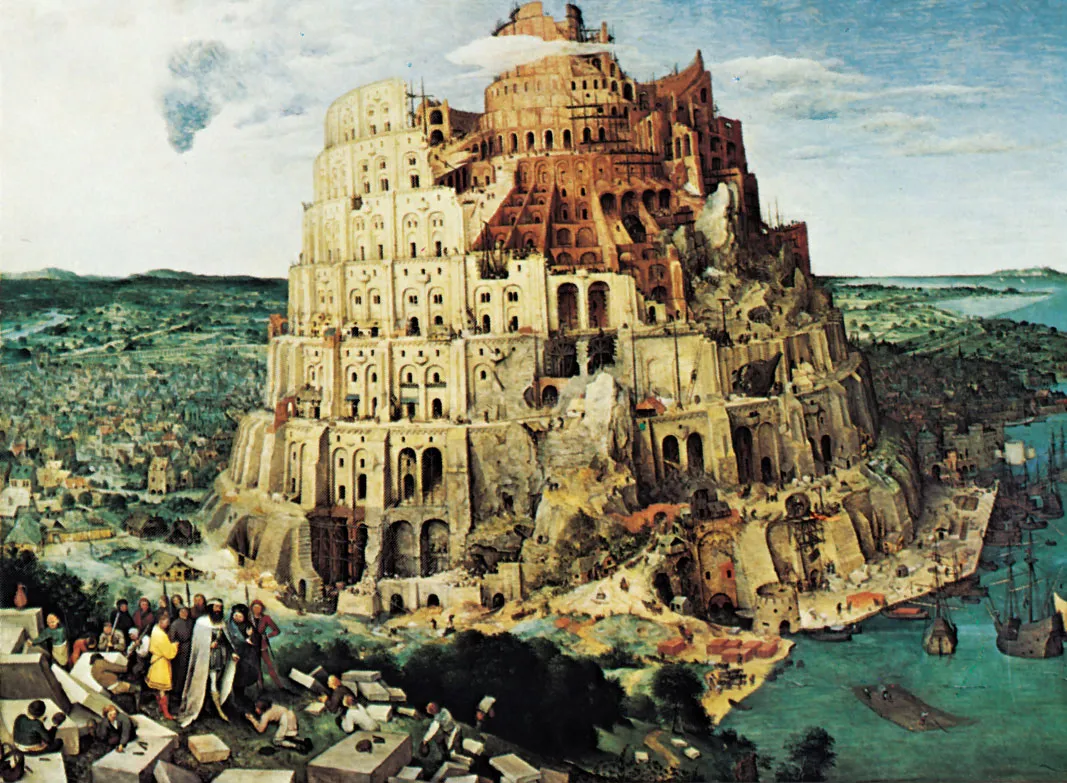
n1-9] The Tower of Babel and the Dispersion. The year of the following narrative is 1996 from Creation, 340 years after the flood. Noah and his children are still alive at this time. Abraham, 48 years old, had already recognised his Creator (Seder Olam). All the nation families were concentrated in present day Iraq [בבל] and they all spoke one language, the Holy Tongue (Rashi), the language with which the world was created (Mizrachi).
Question And yet it says in 10:5 that they all separated according to their language!
All the ingredients for greatness were there. The nations were united, they were in a central location, they spoke the Holy Tongue and — if they desired guidance in achieving holiness — they had Noah, Shem and Abraham amongst them. Instead, as so often happens in human history, they chose to ignore their spiritual advantageous and turn to their opportunities for self-aggrandisement and power. It seems ludicrous that people who had first-hand evidence of the Flood could have found grounds to rationalise a way of bypassing G-d’s control of events, but such is man’s capacity for self-deception that he can negate reality and build substance around a vacuum.
Note This mirrors the Jews complaining in the desert after the Exodus even after having been privy to the multitude of miracles that enabled their escape from oppression.
Note It starts this narrative saying that the whole earth spoke one language, and had a common purpose. However, in the previous chapter (v5, v31,32) it spoke of the descendants of Noah’s children as each one settling (and creating nations) according to their specific language and culture. However, how did such separate cultures arise so quickly. (Once again, no duration of time).
11:5] G-d descends
n11:5] וַיֵּ֣רֶד ה’ ־ — HaShem descended. This is an obvious anthropomophism [the figurative assignment of human characteristics to God]. When God wishes to examine the deeds of lowly Man, Scripture calls it descent. (Radak)
11:7] Let us descend
n11:7] הָ֚בָה נֵֽרְדָ֔ה — Let us descend. The plural indicates that G-d deliberated with His Celestial Court (Rashi). G-d does not need the advice of the angels, but He consulted to set an example that people should show courtesy to others by involving them in discussions and that it is unwise for people to take decisions upon themselves without consulting others.
11:26-27] Terach, father of Abram
n11:26] Birth of Abraham. In a real sense, Creation now begins anew. for it was Abraham who would bear the burden of holiness in the world. His name signified this. At first he was Abram, a contraction of אַב אַרָם father [i.e., teacher] of Aram, for he began as a leader of his own nation, but ultimately he became a father of the whole world. Note This does not seem to be completely accurate. For his influence did not extend to the Far East. However, G-d’s predication that he would become the father of a great and populous nation was true. [see 17:5] (Rashi).
Abraham’s mother was Amatiai, daughter of Karnebo.
n11:28] עַל־פְּנֵ֖י תֶּ֣רַח אָבִ֑יו — during the lifetime of Terah his father. Literally ‘on the face of Terah his father’ meaning ‘during his father’s lifetime’ (Tan. Acharei 7). The Midrash Aggadah (Gen. Rabbah 38:13) tells us that he died on account of his father. For Terah complained about Abram his son before Nimrod for crushing his idols. So he [Nimrod] cast him [Abram] into a fiery furnace, and Haran sat and thought, “If Abram is victorious, I am on his side, and if Nimrod is victorious, I am on his side.” When Abram was saved, they said to Haran, “Whose side are you on?” Haran said to them, “I am on Abram’s side!” They cast him into the fiery furnace and he was burned. This is the meaning of אוּר כַּשְׂדִּים, the fire of the Chaldees. Menachem (Machbereth, p. 32), however, explains אוּר as a valley. Any hole or deep crevice is called אוּר.
11:29] Terach, father of Abram
n11:29] וַיִּקַּ֨ח אַבְרָ֧ם — And Abram … took. When Haran died, his brothers, Abram and Nahor, married his daughters, Sarai and Milcah, to carry on his memory and to assuage Terah’s grief. (Imrei Shefer)
The Seven Noahide Laws
Chronology/Time Lines
Shem to Abram