גבורה
Gevurah
Strength, Restraint, Discipline; Contraction
Transformation through Fear
If love (Chesed) is the basis of human connection, discipline (Gevurah) is the form through which we express love. It gives our life and love shape and focus by forming the energy of Chesed through limiting it. Gevurah—discipline and measure—concentrates and directs our efforts, our desire and love into directions that will emerge in Malchut. Another aspect of Gevurah is respect and awe. Healthy love requires respect for the one you love.
Setting Limits
Breathing quietly, noticing the nature of my experience at this moment, I become more deeply aware of the feelings that are attached to all my thoughts and sensations. Each feeling limits emotional energy and allows it to be experienced and absorbed into my personal space.
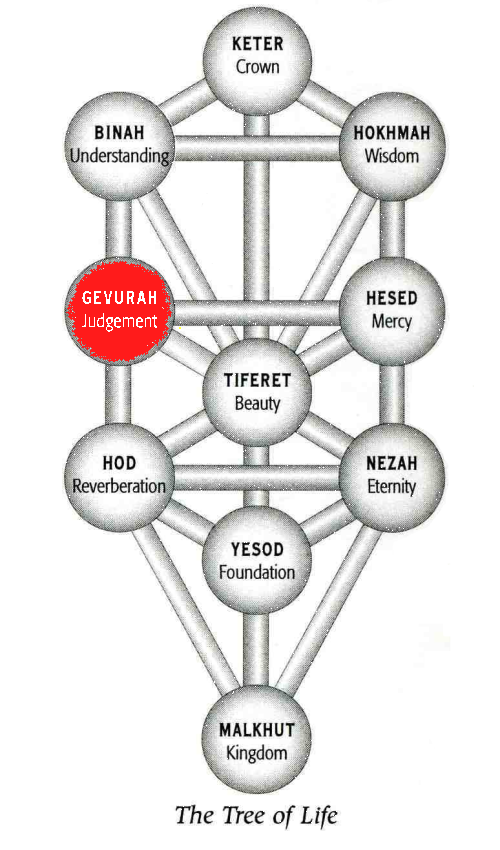
The Sefirah on the Tree of Life
Gevurah, “Strength”, is also known as the sefirah of Judgement, or Din. Gevurah is on the left side of the Tree which represents form. It is within the World of Form that the polarities of our experiences unfold. Gevurah represents those forms we call “feelings”, forms which limit and channel emotional energy. With Gevurah, happiness as well as sadness, pleasure as well as pain, are the emotional forms that emerge in our lives. We cannot know one without the other. Gevurah is thus seen as the origin of “evil”, since it is the place where we first experience “good”, and also the place we encounter the opposite of “good”, and the judgement of both.
The first sefirah on the left side of the Tree is Binah, “Understanding”, but it is at Gevurah that the distinction and polarities that we recognise arise. At Binah, the form which contains the flow from Chochmah, “Wisdom”, is still unitive. Not until emotional form is present can polarity truly be experienced.
Gevurah is the place of limitation, the place at which cold-heartedness enters the world. Gevurah contains whispers of evil, of the “other side”. But Gevurah’s function which requires a great deal of “strength”, is to realise Chesed. We cannot begin to really experience the world until a feeling takes shape in our being. And these feelings begin the moment we are born. Each feeling is itself a limitation of the inimitable flow of life through Chesed. We resist these feelings, we become stuck in them. So caught up in what has become familiar—the roles and scripts around who we are, how we are and why we are the way we are—we close ourselves off from possibilities1 inherent in each moment.
Gevurah is our tendency to cling to our favourite feelings, refusing to release them, thus blocking the nourishing energies of Chesed from flowing more freely into our lives.
The fundamental patterns of creation emerge at Binah, while Gevurah is the space where the polarities—the polarities of our very existence—good and evil, higher or lower, bigger and smaller, better or worse—emerge. The way that feeling limits and holds and shapes emotional energy almost automatically creates its opposite, for feelings are known by their compliments. Without loss, there would be no gain. Without “love”, how would we know “hurt”? Without “excitement”, we could not identify “boredom”.
Gevurah provides the elements of that shapes our days and our nights, the forms that populate our dreams and our nightmares, yet it is absolutely essential to manifest our Creative Energy. This week, focus on your feelings, and bless their gifts. There is no need to resist any feeling, when feelings are allowed into a safe space, and place of truth, they reveal themselves – and from this awareness, I shift.
at Gevurah
is Elohim,
אֵלוהים
Elohim, is the Name associated with judgement and severity, and so is associated with this sefirah. In Jewish tradition, the two most used names of G-d are Elohim and Adonai (written YHVH). Elohim is generally translated as “G-d”, though its meaning is more accurately “G-d of Hosts”. Adonai is generally translated as “Lord” or “Eternal One”.
Elohim is actually the plural form of the noun, yet it is almost always translated as if it were singular, and takes a singular verb and modifier. One way of explaining this is to understand Elohim as the One Being, Adonai, appearing to our awareness as the many. Elohim can be appreciated as the Presence of Adonai within each individual being, enabling us to experience the Immanent aspect of the Divine. This Presence is named Shechinah, which is also another name for Elohim in the ancient mystical text called the Zohar or “Book of Splendour”. Shechinah is also the Presence of the Immanent Adonai present in all living things, as well as Creation itself!
Meditation for the Second Week at Gevurah
הַרְפּ֣וּ וּ֭דְעוּ כִּֽי־אָנֹכִ֣י אֱלֹהִ֑ים
Be still, and know that I am Elohim.
-- (Psalm 46:11)
This exploration requires us to embrace the immediacy of the present moment. As I focus fully and persistently on the contents of my awareness, each moment naturally expands. There is so much more in each moment, in each sensation and feeling, than I ever noticed before.
Sitting and breathing calmly, become aware of your current experience in the world. Focus on your feelings as they arise. Begin to appreciate them without judgement.
Personal Reflections
Shadows are feelings we hold onto.
This starts with the non-acceptance somewhere in our ancestral line of feelings and desires, passed down through the generations, until it becomes embedded in the psyche of the community or nation.
Thus the suppression of a young girl’s feelings could produce a mother/woman who wants people—especially her own children—to express their feelings. For a young boy, whose innocent desires were suppressed, might result in aberrent desires expressed in the realm of relationships.
The suppression of feelings would also result in all sorts of fetish (i.e. material) worship. For instance, alchoholism—or alcho-holism: the religion of worshipping the unholy demon of alchohol—whose holy essences abound and whose worshippers can obtain endless supplies of said essence, which reduces them to becoming mere puppets of its will. Expressing a general principle of said methodology.
Footnotes
There is an implicit hierarchy inherent in each of these possibilities that needs to be eked out. There have to be 3 types of possibilities: positive, negative and neutral (and a 4th, being almost impossible—miraculous maybe?). Positive would be to move the situation towards, what is judged as a positive outcome (then we have a long-term positive outcome—generally requiring a short-term, often immediate, period of discomfort—versus a short-term gain producing long-term pain). Whereas negative would be a capitulation, or unwilling surrender to something that is or constraint imposed by an external force. If the force is internal, then it is a personal issue, generally to do with self-control. The paradoxical nature of the situation is that it might require a negative response in order to “rise another day” for there to be a long-term gain. The other negative response is to do something that is evil, or plain wrong, knowingly or unknowingly that will perpetuate an error or errors in the relationships within the system—generally moving them in the direction of consolidation for power and control. Beware for that is not necessarily a bad thing, if the leaders are honourable. And the leaders can only be honourable if the villages are honourable, which can only occur if the people are honourable and their administrators are true. ↩︎