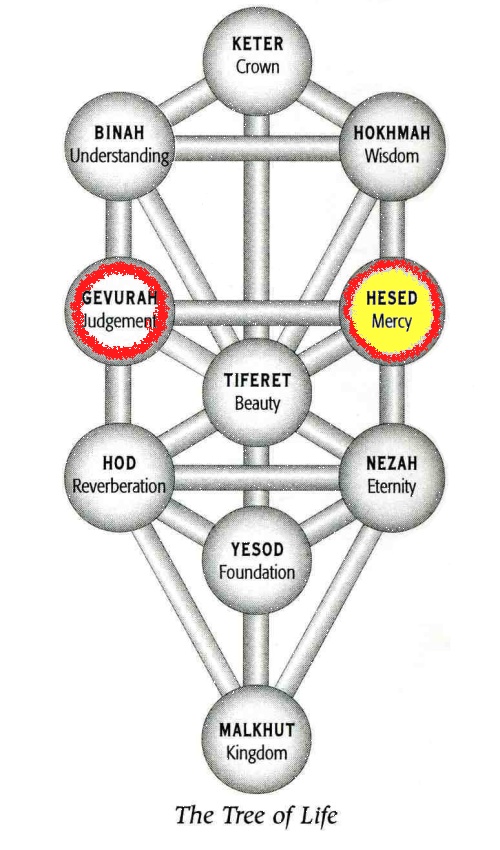
Gevurah she'b Chesed
הָיום שְׁנִי יָמִים לָעוֹמֵרToday is two days of the Omer
Restraint in Love
Healthy love must always include an element of discipline. A degree of distance and respect for the other. Love must be tempered and directed properly. Ask a parent who in the name of love has spoiled his child; or someone who suffocates their spouse with love and doesn't allow her any space of her own. Love with discretion is necessary to avoid giving to those that don't deserve it.
Rain is a blessing only because it falls in drops that don't flood the fields.
The journey from slavery to freedom begins slowly. Into this week of Chesed, representing the Energies of Lovingkindness, Gevurah enters. This is the sefirah that constrains, thus limiting the energy of Chesed to bind it in Forms that nourishe. We experience this as a channel of Light that connects the right shoulder to the left shoulder.
We tend to notice energy expressed in its most abundant form more readily than we do the limitation of that energy, yet without limitation no energy can be harnessed in meaningful ways. We receive Gevurah, the expression of Limitation on the Tree, gratefully, in order to be able to express the Lovingkindness of Chesed. Our heart bridges the gap between operations of mind and expressions of body. From these feelings arise the valuations we place on our perception of self and the world. The forms of these valuations shape our commitments and our pursuits.
We strive to manifest Emotional Forms which will most effectively describe the Emotional Force which flows through us. We need to remain flexible at Gevurah so that we might respond most appropriately to the offerings that flow from Chesed. Through this relationship between Chesed and Gevurah emerges the foundation we need for the next steps in the creative process.
Feelings contain force which can destroy as well as heal. They can express themselves through destructive as well as healing forms. Our work is to encourage Emotional Force to flow more fully by shaping it with Emotional Forms that provide suitable vehicles for that energy.
Personal Reflections
Thank you, O Lord, for the sustenance You provide.
“I receive more fully, so that I may give more truly.”
The Long Road of Exodus
- Every day since we first set foot from Ramses is another day of leaving Egypt.
- As soon as you stop leaving, you are back there again.
- Without limitation no energy can express in meaningful ways.
Notes about Emotions/Feelings
R’ Falcon’s use of the concept of emotional energy, required a dive into the difference between emotions and feelings. As you can see below, I read the normative view of the differences. Where would I find the mystical one, I wonder? Could I propose that emotions are the expression of feelings? Feeling being more from the “soul”, and emotions being more ego-bound?
Emotions originate in the subcortical region, the amygdala, and the ventromedial prefrontal cortices, which cause biochemical reactions to occur and change our physical state.
Because emotions are basically a neurochemical reaction from a stimulus, they are also considered to be unconscious and instinctive. It is possible to bring these emotions out into consciousness through psychotherapy, though.
According to psychologists Paul Ekman and Wallace Friesen, there are six basic emotions that all humans can experience. These emotional responses are:
- Happiness
- Sadness
- Fear
- Disgust
- Anger
- Surprise
- In addition to these six basic emotions and universal facial expressions, there are often sounds that can accompany them. This is known as universal human signalling.
Nonetheless, they are still essential in human interaction and forming relationships with each other, and they have had a crucial role in the evolution of our species since these basic emotions have also been observed in non-human primates, especially the great apes.
In contrast to emotions, feelings originate in the neocortical region of the brain, and they are reactions to the emotions. Feelings form when your brain assigns a meaning to the emotional experience that you are having.
Because they are based on an emotional experience, feelings can be entirely subjective and vary from person to person. If we are to look at any basic emotion that was discussed in the previous section, you can attach the word feel, felt, or feeling to any of them.
For example, you can feel happy or angry, or you felt sad, or you’re feeling disgusted.
Feelings can become even more specific than these emotional responses, though, and they can also be brought up from your physical reactions to various things. Pain and hunger are a couple of examples of this. If you’re injured, you can feel pain, or if you haven’t eaten all day, you’re bound to feel hungry at some point.
All of this indicates that feelings are something that is noticed at the conscious level, and according to Antonio Damasio, who is a professor of Neuroscience at the University of Southern California, feelings are mental experiences of body states and arise as your brain interprets the subconscious emotions.
Unlike emotions, feelings are completely conscious, and this is one of the key differences between them. However, not all conscious experiences are feelings necessarily; you are aware of what you’re seeing or hearing, or any of the primary senses, but they aren’t feelings.
Although they are two separate concepts, as you can see, they aren’t unrelated to each other by any means.
To explain:
The mind “interprets” the feelings that come from the upper, or spiritual, realm as well as the sensations that produce emotions that we receive as a result of our interaction with the world around us.
“Our emotions bridge the gap between operations of mind and expressions of body.”
I would place our mind (the only place we are cognisant of our behaviour) between the spiritual realm and the material realm.
A fundamental difference between feelings and emotions is that feelings arise, mostly from the sub-conscious, while emotions manifest either consciously or subconsciously. Emotion is a “feedback system whose influence on behaviour is indirect.”
Most people want to “feel more positive than negative.” Yet the emotions that cause a positive experience are shown to change between cultures. Or could one separate emotions between those that are influenced by culture and those that are inherent, and not so culturally influenced?
| EMOTIONS versus FEELINGS | ||
|---|---|---|
| Emotions | Feelings | |
| Emotions are physical states that arise as a response to external stimuli | Feelings are mental associations and reactions to sensations | And to thoughts? |
| Aroused before feelings | Caused by emotions | And by spritual influences too? |
| Physical states | Mental associations and reactions | |
| Can be observed through the physical reaction | Can be hidden |
Emotions are natural phenomenon. They can be considered as physical and instinctive since they arise from our bodies’ responses to external stimuli. For example, when you are in an unknown place, you may feel a range of emotions such as curiosity and fear. Since emotions are physical states, they can be measured by physical factors such as facial expressions, body language, blood flow, etc. Emotions are considered to be irrational, illogical and unreasonable since they are carried out by the limbic system, which is separate from the neocortex, which deals with reasoning, conscious thoughts, and decision making.
Feelings are mental experiences of body states, which arise as the brain interprets emotions, themselves physical states arising from the body’s responses to external stimuli.
What arose through trying to make sense of this distinction was the exploration of sensation. When we encounter the spiritual it produces a certain sensation. When we interact with the physical, it produces a different sensation. The upper sensation is given the concept of feeling, the lower that of emotion. When there is an interaction with the spiritual, we can only percieve that through the imaginative faculties of our minds, whereas we receive the physical sensations through our brain-body interactions with our minds, through which we try to give meaning to these sensations.
To my mind, the difference between the two, is that the “receiving”, that is, acknowledging, the spiritual sensation is optional, whereas the physical is not.
- Next: Tiferet in Chesed
- Previous: Chesed in Chesed