N: The and define the two extremes of any space.
https://en.wikipedia.org/wiki/Continuous_function#Continuous_functions_between_topological_spaces
In mathematics, a continuous function is a function such that a small variation of the argument induces a small variation of the value of the function. This implies there are no abrupt changes in value, known as discontinuities.
The epsilon–delta definition of a limit was introduced to formalize the definition of continuity.
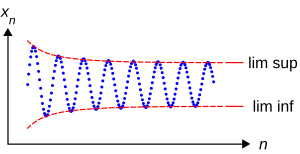
In mathematics, the oscillation of a function or a sequence is a number that quantifies how much that sequence or function varies between its extreme values as it approaches infinity or a point.
Let be a sequence of real numbers. The oscillation of that sequence is defined as the difference (possibly infinite) between the limit superior and limit inferior of :
The oscillation is zero if and only if the sequence converges. It is undefined if and are both equal to or both equal to , that is, if the sequence tends to or .
Examples:
- has oscillation at , and oscillation at other finite and and .
- or 1, −1, 1, −1, 1, −1... has oscillation .
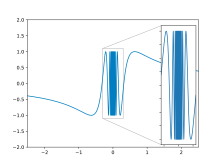
- (the topologist’s sine curve) has oscillation 2 at x = 0, and 0 elsewhere.