Introduction
"Path-working" is a comparatively new phenomenon in Kabbalah, as it does not seem to have existed as a occult practice prior to the emergence of ecstatic Kabbalah in the late fifteenth century. There is an ancient tradition of using the various names of G-d, and the Hebrew letters to journey to the psychic realms, however, the technique of travelling along the paths of the Tree of Life is new.
Simply put, "Path-working" is the art of clairvoyantly investigating the Paths of the Tree of Life.[1] In shamanic terms, it is a form of a guided journey, using the various Sephirot and the Hebrew letters that join them as guidelines and inspiration in the journey of the Tree.
Another technique, making use of this clairvoyant faculty[2] was to re-read the rituals, and then endeavour to walk across a/the Path(s) astrally.
One example given, was that the Seer should formulate in imagination a vast pylon, and within its gates he should visualise the Hebrew Letter Tau, the 32nd Path. Then imagining himself passing through this Letter Tau, and entering the Pylon, he should make appropriate Sacred (Geometric) Symbols, while chanting the Divine Names appropriate to that plane. The resulting vision should be similar to the passage of the Path in the ceremony, but whereas this latter was purely symbolic, the former may be real and dynamic, and may develop into an initiation in the true sense of the word. The same technique may be applied to every Path and to every Sephirah.[3]
Path-working can be used as a means of raising ones consciousness from a lower Sephirah, to a higher one. The actual Path-working consists of a "guided meditation": the leader or facilitator takes the initiates through a guided meditation using the archetypes associated with the Paths on the tree. [4] The leader of the session leaves spaces where the Path-workers can engage in personal, inner reflection, and thereby come up with their own individual insights. There should be a particular method for the "composition of place", i.e. the creation of the astral scene one experiences at the start of the vision.[5]
All forms of Path-working concern learning from astrally experiencing the Paths of the Tree of Life. They always feature the Hebrew letters, and, in the Western Magical traditions, they rely on Tarot Trumps heavily.[6]. This pertains to the Hermetic form, however in the Jewish form the letters representing the path would be the feature to investigate and meditate upon. This is because Path-Working, being a visual exercise, needs some sort of visual focus: hence the images of the letters are the most appropriate for this purpose, and serve to frame the type of vision that ensues.
This points to a field of what I am certain would be a fruitful field of future research, namely, to what extent does arbitrarily changing the symbols involved affect the nature of the Path-working.[7]
Path-working and the Active Imagination
It seems unlikely that what began as an obscure reference in a secret Magical order would have become a popular practice in the Western Mystery Tradition, had it not been assimilated into Analytical Psychology by C. G. Jung. Jung developed a technique called Active Imagination, which is similar to Path-working in that it seems to be mightily similar to Clairvoyance:
… Choose a dream, or some other fantasy-image, and concentrate on it by simply catching hold of it and looking at it. … Then fix this image in the mind by concentrating your attention. Usually it will alter, as the mere fact of contemplating it animates it. The alterations must be carefully noted, for they reflect the psychic processes in the unconscious background, which appear in the form of images consisting of conscious memory material. In this way conscious and unconscious are united, just as a waterfall connects above and below.[8]
Jung goes on to say that instead of merely observing the sequence of events, the individual takes part in the scene, as if he is not the controller of the fantasy sequence, but a participator or character therein. Although, to a certain extent, he looks on from outside, impartially, he is also an acting and suffering figure in the drama of the psyche. This recognition is absolutely necessary and marks an important advance.[9] The ultimate effect of this is, according to Jung, to assimilate lessons from the Unconscious into Consciousness - it thus plays a vital role in the process of "Individuation" - i.e. Jung's term for the process of psychic healing, and the integration of all parts of the psyche.
Active Imagination does not make use of the Tree of Life, nor does it make use of the Tarot Trumps. Yet I believe there is a still a subtle connection. Firstly, Path-working does indeed rely on the Path-worker to "choose a dream, or some other fantasy-image, and concentrate on it".It so happens that the fantasy-image in question is determined by the symbolism of the Tree of Life in general, and the appropriate Hebrew letter in particular. Moreover, the process of Path-working requires the Path-worker to recognise, just as in Active Imagination, that he is a character participating in the vision he is experiencing, not merely an observer, and certainly not its detached creator.
Secondly, Jung himself first developed the Active Imagination technique by practising it himself, when he was going through a time of crisis in his life – he had been traumatised by his break-up with Freud. Jung said, describing the importance of being involved in the vision as opposed to merely an observer, that it is meant to integrate the statements of the unconscious, to assimilate their compensatory content, and thereby produce a whole meaning which alone makes life worth living and, for not a few people, possible at all (my emphasis).[10]
During Jung's Active Imagination sessions, he noticed two types of fantasies recurring: one type was related to images from his own past, but another type were "mythological, archetypal, spiritual, and religious".[11] Jung did not understand how these were connected to his own past, although he did recognise that they were symbols of basic drives common to Mankind across the world and throughout history. This was how Jung began to form his theory of the Collective Unconscious.
The irony here is that the symbolism of the Paths of the Tree of Life is "mythological, archetypal, spiritual, and religious" – because this is exactly with what Kabbalah concerns itself. This occurs primarily through its connection with Torah and the constant working with G-d, the Holy One. Which has preserved and continued to evolve over the centuries the symbolism of the traditional Jewish religion in an unbroken tradition for over four thousand years. The Hebrew letters, being the letter of Creation, are representations of Archetypes of the collective unconscious. [see Wolfson, Aleph, Mem, Tau; the discussion of why the Beit was chosen as the letter to begin the Torah (Zohar), Mishne?]
Hence, whereas it seems that with the Active Imagination, Jung was drawn inadvertently to the archetypes of the Collective Unconscious. In Path-working, the student is deliberately given a set framework within which to experience those archetypes him- or her-self. If we continue the Jungian comparison, we can infer that just as in Analytical Psychology, Active Imagination is a vital tool to effect "Individuation", in the Kabbalah Path-working effects a similar kind of process - it is an aid to help the Path-worker progress along his or her Divine path.[12]
Space prevents me from giving details from all the Path-workings I have surveyed, both mine and other peoples. But I have seen much evidence to indicate that generally, the symbolism of the Paths of the Tree of Life is such that different people tend to obtain similar results when working them. In my experience, the paths take on some of the nature of the Sephiroth which lie at their upper-most end, corresponding closely with my ideas of the grades to which those Sephiroth would be attributed. [13]
All in all Path-working tends to make the Tree of Life far more personal to the individual. At first, the initiate probably only looks on the Tree of Life as a set of correspondences to be memorised: but after Path-working, i.e. experiencing the Tree at a psychic level, the correspondences are connected together in the Initiate's mind through the memories of the astral adventures. It thus becomes easier for the Initiate to invoke those forces in the future, because now they will stir his imagination vividly whereas before they would not.
Furthermore, the experience of Path-working seems to be that the Path-worker goes on a quest to find the lost parts of the self, and finds them through investigating the symbolism of the Tree of Life.
When this is viewed in light of the use of the Hebrew letters thereon, it reinforces the pre-eminence of Hebrew as well – not just as a set of written characters to describe a language, but as a set of symbols of deep significance. One of the side-effects of Path-working must inevitably be that afterwards, a given letter is linked to the mystical revelation which the Path-worker experienced when investigating its corresponding Path. Hence the Path-worker cannot look at Hebrew letters again in the same light: before it was an arbitrary set of symbols; now they stir memories of great psychic import.[14]
Path-working: A Suggested Method
{ Note:
Needs reworking. My concept is to arrange for 10 people (preferably at least 3 men and 3 women, the other 4 can be either), each representing a Sephirah, and then work on the interactions between.
}
The structure of the Path-working session will therefore follow the following lines:
- The preparation of the physical temple, and the Path-worker(s), by a suitable opening;
- The Composition of place. This will itself consist of:
- The visualisation of the starting-point for the path-working;
- The invocation of the angelic forces involved.
- Projection into the visualised scene;
- The main vision, which contrives to reveal to the worker the mysteries of the Path;
- The arrival at the destination-point;
- The closing.
The preparation of the physical temple will involve furnishing it in the appropriate manner - for example, one should use appropriate colours, incense etc.[15]
When walking the Tree of Emergence, which is the first tree to walk, the starting point for the Path-working is the Sephira at the "upper end" of the Path. However, we never start at Keter, but will begin this journey at Chesed. The upper three Sephirot is a study in its own right, and leads us into the esoteric and mysterious aspects of the Tree. When walking the Tree of Return, the starting point for the Path-working is the Sephira at the "lower" end of the Path, and we begin at Malkuth. It is important to note that all walking on this plane is only down with the lower 7, the place of manifestation. The upper have another task, that will need to be visualised and investigated.
Ideally, the method would be to start with Merkava Descent, while studying the Sephirot. The advanced course would be studying the letters on the paths, and investigating what they mean.
All of it is done with "path-working", and journeys.
For each Sephira, we form "a Temple which symbolically represents that Sephira". Hence, the composition of place begins with astrally forming a Temple which symbolically represents that Sephira. The Sephirothic Temple is aligned east-west, east being the direction of Kether, and west the direction of Malkuth. There are portals in the walls, corresponding to where the paths which connect to that Sephiroth would be on the glyph of the Tree of Life. For instance, Yesod:

A vital part of the Composition of place at this point consists of populating this temple with the appropriate God-forms. Among these will be the angel that presides over the Temple; those that represent the Officers of the Temple; the Kerubic angels which guard the four quarters; and the guardians of the Paths leading to and from the Temple.
The Path-working begins by Opening the Temple, and by propitiating the angelic-form - to find out whether one has the right to be in that Sephira in the first place. At the very least this propitiation will consist of saluting with the appropriate grade-sign, and vibrating the Grand Name of that Sephira (e.g.: Yesod - "Shaddai El Chai").
Then, the Path-worker will need to propitiate the God-form that is the Guardian of the Path that they wish to walk - to demonstrate that they are worthy to enter that Path.[16]
| Path | Tarot Trump | Pentagram Ritual |
|---|---|---|
| 11 | The Fool | Air |
| 23 | The Hanged Man | Water |
| 31 | Judgement | Fire Spirit |
When the Guardian of the Portal to the Path in question has been satisfied, the Path-worker then passes through the Portal into the Path itself.
Here one should again vibrate the Divine (and Angelic) names associated with the Astrological or elemental powers to which the Path is attributed. The Divine Names will have been used already in the appropriate ritual. Pictures of a landscape corresponding to the forces of the Path will arise before the mind's eye. Alternatively, the Path-worker may get a strong impression of a scene which fits with the attributions of the Path. In any event, the vibration of the appropriate names - and the foregoing rituals - should serve to call forth a scene which is at least appropriate to the Path.
The first act of the Path-worker, on vibrating the names and establishing the scene is to remain still and call for a Guide to appear. The Guide will be a personification of the Path in question - in name, appearance, and demeanour. The Guide might be might be a God-form corresponding to that path; or it might be an Angel or Spirit qabalistically associated with the path. The Guide might also be a figure which defies easy classification but which nevertheless proves to be appropriate. In any event, the Guide will announce that it recognises the Divine and Angelic names which the Path-worker has been vibrating, and will give the correct sign in salute, where appropriate.
A figure which appears but does not admit to recognising the Divine Names, or the correct Names, nor gives the correct sign, is not a proper Guide. It should be Banished immediately, and the Path-worker should again try to attract a real Guide.
The main part of the Path-working will then consist of the Path-worker exploring the scene, accompanied by the guide. All the while, the Path-worker is attempting to discover, at the mystical, intuitive level, the innate meaning of the path. Practically, this will consist of trying to elicit answers to questions such as:
- What is the symbolic significance of the scenery I am observing? What about the characters I can see in this vision?
- How does what I am experiencing relate to this Path's letter correspondence? To its Astrological or elemental correspondence? To its correspondence in the Sepher Yetzirah?
- How do each of these correspondences relate to each other?
- What about the energy and vibrations associated with this Path? What do I need to know in order to exercise them properly?
- How do I make the transition from the mode of consciousness represented by the Sephira at the beginning of the Path, to that of the Sephira at the end?
- The last question is particularly important, as it is the one that enables the Path-worker to enter the destination Sephira, and thus bring the Path-working to its natural conclusion.
Ideally, the combined effects of the invocations, the visualisations, and the consideration of all the Kabbalistic data regarding that Path will cause the Path-worker to have a flash of intuition which transcends the merely astral phenomena experienced during the Path-working session. This flash of intuition will not merely answer the Path-worker's questions, but will be a source of inspiration for him or her long after the Path-working session has finished.
Assuming that this has happened, the Path-worker may then enter the destination Sephira, in the form of another Sephirothic Temple. The Path-worker should now propitiate the God-form of the destination Temple - by vibrating the Divine Name associated therewith.
The Closing of the session will then consist of closing the Sephirothic Temple - in the sense that the Path-working is essentially an initiation into the destination Sephirah. The Path-worker should thereafter astrally return to Malkuth, so that the energies raised in the session become fully grounded. Only after this has been done should the Path-worker attempt to return to normal consciousness.
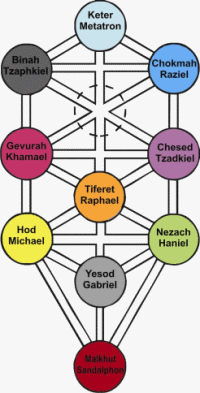
Sephirot

| Sephirah | Divine Name | Angel |
| -------- | ---------------------- | ----------------------------------------- | --------- |
| Keter | Ehieh | Existence | Metatron |
| Chokmah | Yah (Adonai) | The Father Supernal | Raziel |
| Binah | Adonai (Adonai Elohim) | The Mother Supernal | Tzaphqiel |
| Chesed | El | Greatness | Tzadqiel |
| Gevurah | Eloah (Elohim Gibor) | Justice | Khamael |
| Tiferet | Elohim (Eloah Vadaath) | The King | Mikhael |
| Netzach | Adonai Tzabaoth | - | Haniel |
| Hod | Elohim Tzavaot | - | Raphael |
| Yesod | El Chai, Shaddai | - | Gabriel |
| Malkhut | Adonai | Shekinah - The Inferior Mother Sandalphon | Metatron |
Appendix: The Paths of the Tree of Life
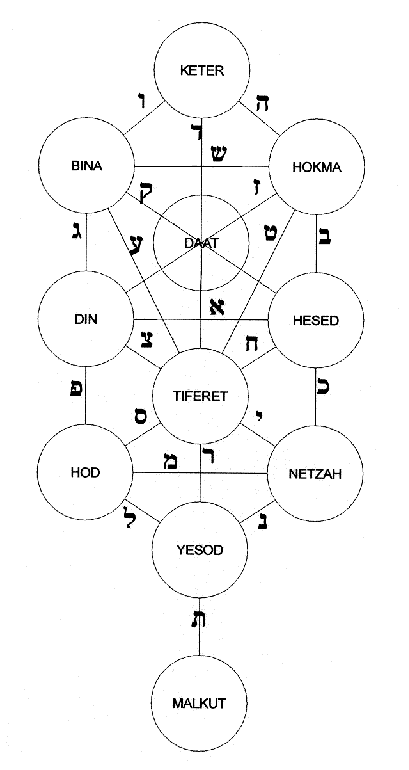
The following table gives the Paths of the Tree of Life, according to the "Golden Dawn" system of classification.
| Path Number[^20] | Sephirah | Hebrew Letter | Divine Name | Angel | Astrological Correspondence |
|---|---|---|---|---|---|
| 11 | Keter - Chokmah | ה - hay | - | - | Air |
| 12 | Keter - Binah | ו - vav | - | - | Mercury |
| 13 | Keter - Tiphereth | ד - daled | - | - | Luna |
| 14 | Chokmah - Binah | שׁ - shin | - | - | Venus |
| 15 | Chokmah - Tiphereth | ט - tet | - | - | Aries |
| 16 | Chokmah - Chesed | ב - beth | - | - | Taurus |
| xx | [Chokmah - Din] | ז - zion | - | - | - |
| 17 | Binah - Tiphereth | ע - ayin | - | - | Gemini |
| 18 | Binah - Geburah | ג - gimel | - | - | |
| yy | Binah - Chesed | ק - kuf | - | - | |
| 19 | Chesed - Geburah | א - aleph | - | - | Leo |
| 20 | Chesed - Tipheret | ח - chet | - | - | Jupiter |
| 21 | Chesed - Netzach | כ - chaf | - | - | Virgo |
| 22 | Geburah - Tiphereth | צ - tzadik | - | - | Libra |
| 23 | Geburah - Hod | פ - peh | - | - | Water |
| 24 | Tiphereth - Netzach | י - yod | - | - | Scorpio |
| 25 | Tiphereth - Yesod | ר - resh | - | - | Sagittarius |
| 26 | Tiphereth - Hod | ס - samech | - | - | Capricorn |
| 27 | Netzach - Hod | מ - mem | - | - | Mars |
| 28 | Netzach - Yesod | נ - nun | - | - | Aquarius |
| 29 | Netzach - Malkuth | - | - | - | Pisces |
| 30 | Hod - Yesod | ל - lamed | - | - | Sol |
| 31 | Hod - Malkuth | - | - | - | Fire or Spirit |
| 32 | Yesod - Malkuth | ת - tau | - | - | Saturn or Earth |
Keter -> Chokmah
Keter -> Binah
Keter -> [Da'at] -> Tipheret
Chokmah <- Keter
Chokmah <-> Binah
Chokmah -> Chesed
Chokmah -> Tipheret
[Chokmah -> Da'at -> Gevurah]
Binah <- Keter
Binah <-> Chockmah
Binah -> Gevurah
Binah -> Tipheret
[Binah -> Da'at -> Chesed]
Chesed <- Chokmah
Chesed <-> Gevurah
Chesed -> Tipheret
Chesed -> Netzach
[Chesed <- Da'at <- Binah]
Gevurah <- Binah
Gevurah <-> Chesed
Gevurah -> Tipheret
Gevurah -> Hod
[Gevurah <- Da'at <- Chokmah]
Tipheret <- [Da'at] <- Keter
Tipheret <- Chokmah
Tipheret <- Binah
Tipheret <- Chesed
Tipheret <- Gevurah
Tipheret -> Netzach
Tipheret -> Hod
Netzach <- Chesed
Netzach <- Tipheret
Netzach <-> Hod
Netzach -> Yesod
(Netzach -> Malkuth)
Hod <- Gevurah
Hod <- Tipheret
Hod <-> Netzach
Hod -> Yesod
(Hod -> Malkuth)
Yesod <- Tipheret
Yesod <- Netzach
Yesod <- Hod
Yesod -> Malkuth
Malkuth - Yesod
(Malkut - Netzach)
(Malkut - Hod)
Acknowledgement
I would like to thank all the members of the MSN Community "Pathworking Symposium", some of whose contributions to that forum I feature in this article.
Bibliography
Crowley, Aleister : 777
Crowley, Aleister: The Book of Thoth.
Crowley, Vivianne: Jungian Spirituality, Thorsons, 1998.
Denning, Melitta and Phillips, Osborne : The Sword and the Serpent
Fortune, Dion : The Mystical Qabalah New Edition, Thoth.
Jung, Carl Gustav: Collected Works, Volume 14.
Regardie, Israel : The Art and Meaning of Magic, Helios 1969.
Regardie, Israel: The Golden Dawn, 6th Edition, Llewellyn Publications 1989.
Williams, J. L.: The Rites of Life: Pathworking, Tarot and the Qabalistic Tree of Life, 2001.
Zalewski, Patrick : Secret Inner Order Rituals of the Golden Dawn, Falcon Press 1988.
Footnotes
"With regard to Earth, it was considered adequate to make the letter Tau, belonging to Saturn, correspond also to Earth.
"These additions are clear evidence that the Tarot took definite and arbitrary steps to assert the new discovery in Magick some two thousand years ago; for no system is more rigid than a Hebrew system. And the system of the Sepher Yetzirah is the deepest rooted of all the elements of the Hebrew system, the most dogmatic of them all."
The Book of Thoth, Aleister Crowley, III The Atu of Tahuti.
[20]The Path Number corresponds to the Path of the Sepher Yetzirah, and to the row in 777.
But do the Paths of the Tree of Life really represent a valid set of Archetypes?
It is possible to test this, by seeing how different individuals' experiences of Path-working compare. Let us assume that these individuals each explore a given path, each relying on their own "clairvoyant faculty" (or Active Imagination) to provide their data, and not passively indulging in a completely guided meditation. If the Paths are indeed Archetypal, we should expect to see that the visions produced all share common characteristics, which go beyond what is suggested by the conscious imagery of those Paths. In a series of surveys over the past 6 months, I did see that this was in fact the case.
{Note: Why would judgement be associated with this, the 31st path? Would it not be better associated with a path that extends from Din/Gevurah itself? As this is the Sephirah that represents Judgement in the Tree.}
Let us take, for example, the Thirty First Path of the Tree of Life, which is associated with Fire, and with the Tarot Trump "Judgement". I present three excerpts from Path-workings - the first, by myself, which I did approximately two years ago. The second two are accounts which I discovered much more recently: one is from the Aurum Solis, and the other is by the writer J. L. Williams.
...[W]hy associate Fire with Judgement? In a flash of inspiration the answer came - the Trial by Ordeal. In olden times fire was used as a means of trying a person. Whilst the literal use of real fire is obviously crude, yet the metaphysical equivalent is still valid. It is part of the Spiritual path to undergo a Trial by Ordeal - although it is painful, the truth (i.e. the constancy of ones commitment) will eventually ensure one wins through.
Alex Sumner
...We become aware of a throng of beings therein, a throng scarcely perceptible even to our new consciousness, beings of a nature more entirely spiritual than we have previously encountered. The united gaze of great brilliant eyes is fixed silently upon us as we pass through their ranks. We are to be in some unknown manner put to the test, proved by the fire."
Aurum Solis[17]
What is meant by this "redeeming Fire"? To many, this sounds overwhelmingly oppressive. However, nestled firmly in this evasive language is an important thought: When we release our worries, both corporeal and ethereal, to the process (that which is the tide of life, of the forces of the cosmos and that which gives us momentum, motivation and divine inspiration), we do not release our responsibilities - instead, we release all predestined thought, all guilt, all blame, all expectancy (no lust for result), and in the process we find ourselves empty and ready to WORK."
J. L. Williams[18]
The first thing we notice is that in each of the three passages the Path-workers get the idea of a Trial by Fire, or Proving by Fire. The sense is that the Thirty First Path is encountered at an early stage of an Initiate's career (it joins Malkuth to Hod): hence, it represents an initiatory phase that the young aspirant has to go through. Specifically, it feels like a burning away of redundant aspects of the personality.
]
{Note: This is another hermetic interpretation that I am not sure that I agree with. I think that Aryeh Kaplan's explanation in the Sefer Yetzirah is much more accurate and in line with the Kabbalah.}
The paths
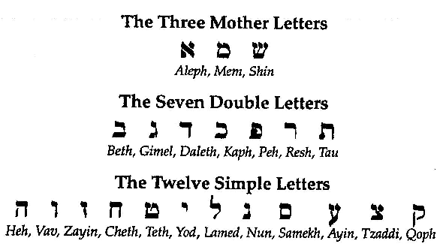
- ק,שׁ,ה - Basic initiatory challenges for the aspirant;
- פ,צ,ר - qualities of the Personality;
- ס,נ,ע - the conflict between materialism (Sensuality) and asceticism (Spirituality) (N.B. these are the paths which form the bridge between the Personality and Individuality);
- ט,י,כ,ל,מ - qualities of higher Adeptship;
- ו,ה,ג,ח,ז - ways of making the transition to Supernal consciousness (these are the paths which "Cross the abyss");
- א,ב,ד - highest, most abstract Theurgy. {Note: This should be א,מ,שׁ, the three mother letters}
]
| Path | Tarot Trump | Hexagram Ritual | Planet |
|---|---|---|---|
| 15 | The Emperor | Aries | Mars |
| 16 | The Hierophant | Taurus | Venus |
| 17 | The Lovers | Gemini | Mercury |
| 18 | The Chariot | Cancer | Moon |
| 19 | Strength | Leo | Sun |
| 20 | The Hermit | Virgo | Mercury |
| 22 | Justice | Libra | Venus |
| 24 | Death | Scorpio | Mars |
| 25 | Temperance | Sagittarius | Jupiter |
| 26 | The Devil | Capricorn | Saturn |
| 28 | The Star | Aquarius | Saturn |
| 29 | The Moon | Pisces | Jupiter |
| Path | Tarot Trump | Pentagram Ritual |
|---|---|---|
| 12 | The Magician | Mercury |
| 13 | The High Priestess | Moon |
| 14 | The Empress | Venus |
| 21 | The Wheel of Fortune | Jupiter |
| 27 | The Tower | Mars |
| 30 | The Sun | Sun |
| 32 | The Universe | Saturn, Earth |
Footnotes
Path-working as a technique seems to have developed from the clairvoyant practices of Adepts in the Stella Matutina - one of the off-shoots of the Golden Dawn. ↩︎
This technique was as described in a paper recording a lecture by Frater Sub Spe by J. W. Brodie-Innes. ↩︎
Israel Regardie, "The Golden Dawn", pp. 463 - 464. ↩︎
For example, in the Aurum Solis as described by Denning & Phillips, op. cit. ↩︎
Dion Fortune, on the other hand, is in favour of such guided meditations up to a point, but agrees with the need to allow the meditator time and space for their own personal images to emerge. Fortune, op. cit. ↩︎
In talking about the Paths of the Tree of Life, and Tarot Card attributions, I am mainly referring to the "Golden Dawn" attributions, which are the ones used by the majority of practitioners in the Western Mystery Tradition today. However, a significant number of people have argued for a different set of attributions, for example, Aleister Crowley. Although in his 1907 reference book 777 he published the Golden Dawn attributions, his later work on the Tarot, The Book of Thoth departs from this scheme in that "The Star" and "The Emperor" are placed on (what were) each others' paths ה and צ.For Crowley's reasoning as to why this swap is made, see "The Book of Thoth", III The Roman Numbers of the Trumps. ↩︎
A different, though slightly related question is whether it matters if one uses the traditional tree from that designed by Isaac Luria; or whether some version such as the modern Hermetic Kirscher Tree of Life is equally or more conducive to Path-working. This will be answered at a later date. ↩︎
Jung, The Conjunction, "Collected Works", Vol 14, par. 706. ↩︎
Ibid., par. 753. ↩︎
Ibid. par. 756. ↩︎
Jungian Spirituality, Vivianne Crowley, p.45. ↩︎
[ ↩︎
[
For example: ↩︎{ Note: This is an interesting stretch to achieve using the Hebrew letters for pathworking on the Tree! This is what we have to reach for.
}
When this is viewed in light of the use of the Major Arcana therein, it reinforces the pre-eminence of the Tarot as well – not just as a method of mere fortune-telling, but as a set of symbols of deep psychological significance. One of the side-effects of Path-working must inevitably be that afterwards, a given Tarot Trump is linked to the mystical revelation which the Path-worker experienced when investigating its corresponding Path. Hence the Path-worker cannot look at the Tarot again in the same light: before it was an arbitrary set of symbols; now they stir memories of great psychic import. ↩︎{ Note: What ceremony would be used at the opening?}
The opening in the very least will include the Lesser Banishing Rituals of the Pentagram and Hexagram. ↩︎The following three tables give the correspondences - from a "Golden Dawn" point of view. For Zodiacal signs, the Hexagram ritual may be performed in addition to the Pentagram ritual, as the influence of the planetary can often be "felt" just as much as can the Sign's Triplicity. ↩︎
Dennings & Phillips, op. cit. ↩︎
The Rites of Life: Pathworking, Tarot and the Qabalistic Tree of Life J.L. Williams, 2001. See excerpts from the book. ↩︎